
Welcome to
the Forum
Engage innovators and practitioners on the edge of technology advancement.











.webp)
2026 Predictions: The Year Humanoid Robotics Gets Real
It’s predictions season again, which means tech LinkedIn is about to be flooded with hot takes like “this is the year that ‘Mining on the South side of the Moon’ will get real.” Spoiler alert: humanoid robots won’t be folding your laundry by February, but I am watching this space reach an actual inflection point. Here’s what I think 2026 holds for humanoid robotics.
Prediction 1: Hardware Takes a Backseat to Intelligence
The humanoid hardware race has been exhilarating to watch, with many demos and initial customer deployments. But 2026 won’t be about more impressive backflips or faster walking speeds. We’ll hit the “hardware plateau,” where physical capabilities are good enough for real-world deployment and the bottleneck shifts entirely to intelligence and adaptability.
The winners will be companies whose robots can understand context, learn from observation, and respond appropriately to messy, unpredictable human environments. Foundation models trained on internet-scale data are already getting grounded in physical robotics. Expect humanoids that can genuinely learn new tasks by watching humans perform them once or twice, rather than requiring thousands of hours of simulation.
Prediction 2: Humanoids Move from Warehouses to Living Rooms
2026 will be the year humanoid robotics makes its first serious push into personal and healthcare settings. Not because the technology is perfect, but because the need is urgent and growing.
Our aging population crisis is not waiting for perfect robots. We are facing a caregiver shortage that no amount of policy can solve. Humanoid robots that can assist with basic tasks, provide companionship, and alert human caregivers to problems will move from pilot programs to early commercial deployment.
This is where my work at Machani Robotics comes in. We are developing AI companions that can sense, understand, and respond to human emotion with authenticity. The technical challenge is creating robots that know context: when someone needs encouragement versus space, when to start a conversation versus sitting quietly nearby.
Prediction 3: Emotional Intelligence Becomes the Key Differentiator
Here’s my boldest prediction: emotional intelligence will become the deciding factor in humanoid robotics, and companies that ignore this will fail regardless of their hardware prowess.
As humanoids enter our homes, the question is not “can this robot lift 50 pounds?” It’s “will my grandmother trust this robot?” That trust comes from emotional attunement, not payload capacity. We need less Ultron, more Vision.
The breakthrough will come from combining multimodal AI (systems that simultaneously process facial expressions, voice tone, body language, and context) with robotics. In 2026, expect humanoids that can read a room, adjust behavior based on mood, and provide genuine companionship rather than just task completion.
Prediction 4: The Standards Battle Begins in Earnest
We are deploying humanoid robots without agreed-upon standards for how they should behave, communicate, or share data. Every company builds proprietary systems. This fragmentation is dangerous when healthcare facilities need to integrate humanoids from multiple manufacturers. The Avengers had a hard enough time working together, and they at least spoke the same language.
I predict 2026 will see industry consortiums forming to establish baseline standards covering safety protocols, emergency shutdown procedures, data privacy, and interoperability. My hope is that we prioritize human-centered standards from the start. Not just technical specs for joint torque, but standards for how robots signal intentions, respect personal space, and handle emotional data.
Prediction 5: Regulation and Consolidation Reshape the Industry
2026 will bring our first serious regulatory frameworks for humanoid robots in homes and public spaces, with the European Union likely leading through extensions of their AI act. This will separate serious players from demo companies and drive industry consolidation.
Investment will flow toward companies with clear paths to revenue and specific use cases in senior care, hospitality, and security. The talent war will intensify, particularly for systems engineers who understand both physical and cognitive aspects of humanoid systems.
The companies that succeed will actively involve ethicists, mental health professionals, and diverse communities in their design process from the beginning. Standards and regulations alone will not build trust. Transparent development and genuine commitment to safety will.
What Success Looks Like
I am more excited than ever about what humanoid robotics can do for human flourishing. Not because robots will replace human connection, but because they can amplify our capacity to care for each other and help people truly thrive.
The measure of success in 2026 will not be how human-like our robots look or how smoothly they walk. It will be whether they unlock fuller, richer lives. Can they help an elderly person not just maintain independence, but pursue new hobbies and stay engaged with their community? Can they give caregivers not just relief, but the space to be present and connected rather than exhausted? Can they provide companionship that helps someone flourish, not just cope with loneliness?
We stand at a rare moment where technology, need, and capability are converging. This is not about robots helping us survive with dignity. It’s about technology that helps us live with joy, purpose, and deeper human connection. The question is not whether humanoid robotics will transform how we care for each other. It’s whether we will build a future where technology elevates what it means to be human.
2026 will show us how close we are to making it real. As computer scientist Alan Kay said, “The best way to predict the future is to invent it.”

Giga Computing: Rack-Scale, Regional, and Ready for Inference
I recently caught up with Giga Computing’s Chen Lee about what’s really changing inside AI data centers. Spoiler: it’s not just bigger racks and faster GPUs. It’s how those racks get built, where they’re assembled, and how we plan for a world where inference becomes the dominant workload pattern.
One of the threads in our discussion was Giga Computing’s push on circularity—reclaiming, sorting, and returning components to a second life. Chen was candid: yes, circular practices eliminate waste and can reduce some costs, but they’re not a pure economic play. There’s real human work in sorting and qualification. The point isn’t cost-first; it’s responsibility-first—answering “the call for Earth,” as he put it. That framing matters. At OCP, sustainability isn’t a backdrop; it’s a design constraint. And circularity is moving from “nice to have” to “show me your plan.”
Why Inference Changes the Rack
Training may steal the headlines—and budgets—but inference is the business. Chen’s view is that the next expansion wave will be dominated by inference-centric racks that look and behave differently: more elastically scaled, more network-sensitive, and more tightly integrated with edge and enterprise fabrics. That opens new addressable markets across sectors—healthcare, finance, oil and gas, education, government—each with unique latency, privacy, and cost envelopes. If training is a few giant mountains, inference is a mountain range: broader, more varied, and much closer to the users who depend on it.
Modularity is the Multiplier
Giga Computing’s emphasis is modularity: building blocks that let operators configure for today’s sprint and tomorrow’s pivot. In practice, modularity shortens time-to-capacity, smooths upgrades, and lowers the operational blast radius when something changes—like a new model family, memory footprint, or accelerator ratio. The companies winning rack scale are the ones who treat integration, test, and validation as first-class products—not just a step between BOM and shipment.
Proximity is Performance: Why Local Build Matters
A second pillar: U.S.-based assembly. Giga Computing is standing up local capability to improve lead times, reduce shipping risk, and cut carbon that comes with long logistics chains. There’s also a quality and reliability angle that’s easy to overlook: racks that don’t spend weeks getting rattled across oceans arrive with fewer transport-induced gremlins, making burn-in and final test more predictive. Chen flagged SKD approaches that enable “Assembled in America” servers—another lever for responsiveness when demand spikes and when regulatory or customer requirements insist on a regional footprint. In a supply chain still healing from 2020–2022 shocks, proximity is performance.
The Revolution—Tempered with Responsibility
Chen was direct about the macro arc: AI’s disruption dwarfs the industrial revolution. That’s not hyperbole on the OCP show floor; it’s the operating assumption for everyone building AI factories. But the second clause matters: be careful about the road we go down. For vendors, that means shipping capacity with guardrails—power-aware, grid-friendly, and supportable. For operators, it means designing for efficiency, circularity, and people—because the most constrained resource in this market might be expert hands, not megawatts.
It’s clear that Giga Computing is leaning into OCP’s core ethos—openness, efficiency, and scalability—while aligning to the buyer reality of 2025: more inference, faster turns, and a stricter carbon ledger. The choice to invest in U.S. assembly is a clear signal. The focus on modular rack-scale integration is another. And the honesty about circularity’s costs—and its necessity—reads as maturity, not marketing.
But the larger takeaway is ecosystem-level: OCP’s center of gravity is shifting from “can we build it?” to “can we scale it responsibly, locally, and profitably?” As AI diffuses into every sector, vendors that align on all three tend to be better positioned to keep shipping through the next wave.
If you want to learn more, Chen points to Giga Computing’s site and his LinkedIn.
TechArena Take
The ground is shifting under data center infrastructure—away from one-off training builds toward the day-to-day realities of inference at scale, tighter lead times, and verifiable sustainability. In that context, Giga Computing is getting more sophisticated in addressing enterprise requirements—focusing on modular rack integration, treating circularity as an engineering process, and leaning into regional assembly for predictability and QA.

8 Ways Power, Policy, & Public Trust will Reshape Data Centers
In Part 1 of this series, we looked at the physical side of the transformation – AI factories, 800 VDC, liquid cooling, and circular infrastructure.
But hardware is only half the story.
As we move into 2026, data centers are not just engineering projects. They are instruments of national policy, flashpoints for public debate, and symbols of digital sovereignty. The young data center industry is maturing fast and starting to behave more like a utility: tied to power and water infrastructure, wrapped in regulation, and caught up in geopolitics.
This second part looks at how power, policy, and public trust will push data centers further into “utility” territory in 2026.
1. Data Centers are Treated as Critical National Infrastructure
In 2026, more governments will treat data centers as critical national infrastructure, on par with power, water, and telecom.
Mega-scale AI campuses are already collaborating directly with utilities on long-term power contracts and grid planning. National digital strategies increasingly call out data centers as strategic assets.
The next step is structural. Expect more state-owned or majority-stake data center entities in markets where digital sovereignty is a priority. In some countries, the same organizations that run power or fiber networks will also operate core data center capacity. Power and data will converge not just technically, but institutionally. On the flip side, commercial could take over utilities, like we saw when Microsoft took over a nuclear power plant. The possibilities beg the question, which model will prevail?
2. Backlash Forces a New Social License to Operate
At the same time, the anti-data center movement will keep growing.
Energy and water consumption are obvious flashpoints. In EMEA, regulations are already forcing operators to justify every megawatt and liter. In the US, the rules are looser, but community pushback is rising, especially where people feel surrounded by new builds.
In 2026, “build it and they will come” will not cut it. Large projects that do not engage communities – and clearly demonstrate local benefits – will face protests, legal hurdles, or outright rejection.
Operators will need a social license to operate: transparent reporting on resource use, clear community benefit programs, and honest conversations about trade-offs. Data centers are here to stay; invisible, unaccountable ones are not.
3. Heat Reuse and Water Stewardship Become Conditions for Growth
Governments are starting to use the strongest lever they have: tying growth to resource efficiency.
Heat recycling is moving from ESG slideware to hard requirement. EU rules are pushing toward mandatory heat reuse for new facilities. Selling excess heat into district networks can offset a real share of energy costs – if the infrastructure or use-case exists.
Most older sites were not built to capture and reuse heat; retrofitting is expensive. New builds, however, will be expected to integrate with local heating systems or other industrial processes that can absorb waste heat. Water will follow a similar pattern: regions under stress will demand closed-loop cooling, reuse, or alternative technologies.
By the end of 2026, heat and water plans will be as central to a data center proposal as power budgets and fiber routes.
4. Sovereignty and Cloud Repatriation Reshape Capacity
Sovereignty is becoming one of the main forces shaping where data center and AI capacity is built.
Nations want control over their data, their models, and their digital infrastructure. High-profile outages at large cloud providers reminded everyone that concentrating critical workloads with a few global players creates a huge single point of failure.
This does not mean cloud is dead. But the growth curve will bend. In 2026, expect slightly slower cloud adoption and more deliberate hybrid strategies, especially in regulated and sovereign contexts.
Public-private regional clouds, national AI platforms, and targeted repatriation of sensitive workloads will create a more distributed, sovereignty-aware data center landscape. Compute becomes a strategic resource, not just an IT line item.
5. Export Controls and Tech Nationalism Redraw the Map
As data centers become tied to AI and quantum capabilities, export controls will tighten.
Advanced GPUs, high-bandwidth memory, accelerators, and some quantum and networking components are already restricted in certain corridors. In 2026, controls will broaden to cover more hardware, software, and services.
For operators, this reshapes the global map. Some countries will struggle to access cutting-edge hardware. Others will double down on domestic design and manufacturing to reduce dependencies. Cross-border partnerships will need careful navigation to stay on the right side of the rules.
Tech nationalism is not new, but AI raises the stakes. Data centers now sit inside a broader geopolitical conversation about who controls the next wave of economic and security advantage.
6. AI Hits the Trough of Disillusionment – and Ethics Gets Real
As AI enters Gartner’s “trough of disillusionment,” hype will wobble, but real use cases will continue to grow.
Alongside that, AI will create new ethical headaches: deepfakes, synthetic media, biased models, opaque decisions about credit, hiring, healthcare, and access to services.
In 2026, digital ethics starts to get operationalized:
- Regulators demand explainability, audit trails, and governance for AI systems.
- Enterprises must show not just performance, but fairness and responsible data use.
- Tools for detecting synthetic content become part of the security and trust stack.
Culture will feel this too. It is not hard to imagine a first Hollywood-grade AI-generated movie success sparking fresh debates about authorship and creativity.
7. The Public Finally Learns What a Data Center Is
Most people still treat “the cloud” as something abstract. They do not picture the buildings, power lines, and water systems behind their apps. That will begin to change in 2026.
As data centers appear more often in headlines – around energy, outages, sovereignty, or ethics – operators and governments will need to get better at explaining them. Expect more transparency dashboards, open days, and school or community programs.
8. Data Centers Start to Classify Themselves Like Power Plants
As the industry matures, “data center” becomes too generic. Not all sites serve the same role, and in 2026 that will show up more clearly in how they are described and regulated.
Categories will solidify:
- AI factories: dense, power-intensive sites optimized for training and large-scale inference.
- Network hubs: interconnect-heavy facilities focused on peering and content distribution.
- Cloud/general-purpose sites: mixed-use environments for a wide range of workloads.
Operators will increasingly lean into this language. Regulators and utilities will follow, tailoring expectations to the facility type. An AI factory next to a small town is not the same as a modest enterprise colo – and it should not be treated as such.
The Road Ahead: Utilities with a Digital Core
On the inside, data centers are being rebuilt around AI, power efficiency, and circular infrastructure. On the outside, they are being pulled into national strategy, community impact, and digital ethics.
The question for 2026 is not whether data centers become more utility-like. That is already happening. The real question is how well the industry can balance three things: relentless demand for compute, finite natural resources, and a society that is only just waking up to how dependent it has become on all this hidden infrastructure.
Using the Power of Micro Grids to Feed AI’s Insatiable Appetite
Data centers have always been power hungry, but the AI revolution has transformed them into energy consumers on an unprecedented scale. My recent conversation at the Open Compute Project Global Summit with Dr. Andrew A. Chien, professor of computer science at the University of Chicago and senior scientist at Argonne National Laboratory, alongside Solidigm’s Jeniece Wnorowski, revealed how AI’s insatiable appetite for energy is forcing a fundamental rethink of data center infrastructure.
Andrew brings a unique perspective to these challenges. He has worked both in academia and the information technology industry, including as a senior executive leading research at Intel. Through his journey, he’s learned which problems academics are uniquely positioned to solve versus those better suited for industry. His current focus spans two areas: accelerators for scalable graph analytics, and how data centers interact with the power grid. The latter brought him to OCP Summit.
The Power Density Challenge
The trends driving change are impossible to ignore. Andrew said he began thinking about the trend toward higher power density more than a decade ago. “I’d sort of figured Moore’s Law was coming to an end,” he said. “And that means that computing, which we seem to have an infinite appetite for, was going to consumer more and more power.” Anticipating this, he launched the Zero-carbon Cloud project to explore how data centers might harmonize with an increasingly renewable-based power grid.
The challenge extends beyond raw megawatts. As power grids transition to renewable sources, they’re becoming inherently volatile. Solar and wind generation fluctuate based on weather and time of day, creating periods of abundance and scarcity. Data centers, designed to run flat out at full load to maximize value, must now find ways to coexist with this fluctuating supply without sacrificing performance or reliability.
Micro Grids as the Bridge
Andrew’s solution centers on micro grids that provide flexibility in how data centers consume power and manage thermal loads. The concept addresses the fact that power grids are built to meet peak demand, which means they face stress during just one percent of the year. During those peak moments, if data centers could back off slightly from their demand on the main power grid for a few hours, they could dramatically ease its strain.
With a micro grid in place, such an offload could be possible without disrupting operations in the data center. AI training, inference, and other computing workloads could continue to run nearly uninterrupted, while the grid gains the breathing room it needs during stress periods. The micro grid would act as a buffer, filling gaps between what the grid can provide and what the data center requires.
Andrew’s recent research demonstrates that these power micro grids can be deployed as a small fraction of total data center cost. Lightweight generators and small-scale storage technologies make the approach economically viable even for massive facilities. The technology exists and is affordable relative to overall data center investments.
Breaking New Ground
If the technology is ready and cost-effective, what’s holding back adoption? Andrew identified two primary barriers, neither purely technical. First comes the question of who pays. Second, and perhaps more complex, is establishing clear responsibility between data center operators and power utilities.
Current debates between data center companies and power grids focus on connection costs and shared responsibilities. These discussions are breaking new ground, creating precedents for an entirely new relationship between computing infrastructure and energy systems. Andrew emphasized a lesson from his industry experience. “It’s not that industry won’t pay. It’s they want everyone to pay fairly. They don’t want to be disadvantaged,” he noted. With clear standards in place, he says, “We can have our cake and eat it too.”
The cultural challenge may prove equally significant. Data center operations have historically prioritized reliability above all else, with infrastructure optimized for stable, predictable conditions. Moving to dynamically managed systems that respond to fluctuating power availability requires embracing flexibility in an industry built on consistency. For organizations where reliability culture defines their identity, this shift can feel uncomfortable.
Beyond AI
While AI dominates current data center conversations, Andrew sees the massive infrastructure being built today as enabling far more than machine learning. The scale of computing infrastructure now available will support diverse applications and create opportunities across many domains. “There are other kinds of computing that are going to be enriching our lives, creating commercial opportunity, leading to exciting research for many more years to come,” he says.
TechArena Take
Andrew A. Chien’s work illuminates the infrastructure challenges hiding beneath AI’s exponential growth. His vision of micro grid-enabled data centers is a fascinating blueprint for sustainable computing at scale. As renewable energy transforms power grids and AI-enhanced workloads push data centers to new extremes, the solutions emerging from collaborations between academia, industry, and organizations like OCP will determine whether we can support computing’s future. The path forward requires not just technology but clear standards, shared responsibility, and willingness to embrace dynamic management in an industry built on stability.
Learn more about Andrew’s research at the University of Chicago Computer Science website.

Marvell Inks $5.5B Celestial AI Deal to Break Memory Wall
Marvell Technology has entered into a definitive agreement to acquire Santa Clara-based Celestial AI. The transaction is valued at $3.25 billion upfront, with approximately $1 billion in cash and $2.25 billion in stock. There is an additional $2.25 billion in potential earnouts based on revenue milestones.
The deal is expected to close in early 2026.
While Celestial AI is not yet a household name, the acquisition would give Marvell control over one of the most critical technologies in hyperscale architecture: the "Photonic Fabric." Celestial specializes in optical interconnects designed to separate memory from compute.
In current AI infrastructure, chips like NVIDIA’s Blackwell are often bottlenecked by how fast they can fetch data from local memory. Celestial AI uses light (photonics) rather than copper electricity to fetch data from remote memory pools at speeds and latencies that mimic being on-chip. If successful, this acquisition allows Marvell to sell the essential optical plumbing required for the next generation of massive AI clusters.
The Context
This acquisition arrives at a critical inflection point for AI infrastructure in late 2025:
- The "Memory Wall" is Here: Frontier LLMs have grown so large that they no longer fit on a single GPU—and for training, often not on a single rack. The bottleneck for training next-gen models isn't how fast the chip calculates (FLOPS), but how fast it can move data (Bandwidth).
- Copper is Dying: Traditional electrical interconnects (copper wires) are hitting physics limits. They get too hot and lose too much signal over distances longer than a few meters. To build the “million-chip clusters” planned by OpenAI and Microsoft, data centers are shifting to light.
- The Marvell vs. Broadcom War: This is a direct shot at Broadcom. While Broadcom dominates the standard switching market, Marvell is positioning itself as the king of custom AI plumbing. By owning Celestial, Marvell can offer a full optical stack—DSP, Switch, and now the Interconnect Fabric itself—to hyperscalers who want to build their own custom AI clusters.
TechArena Take: The Optical Moat Strategy
If the Palo Alto/CyberArk deals of 2025 were about building a "Moat of Trust" (software), this deal is Marvell attempting to dig a "Moat of Light" (hardware).
We view this acquisition as a defensive masterstroke and a high-risk integration challenge:
- For years, architects have dreamed of “disaggregated computing”—where you have racks of just GPUs connected to racks of just memory, all sharing data instantly. It seemed like a pipe dream because the latency was too high. Marvell spending $3.25B upfront on Celestial is the industry’s strongest signal yet that optical disaggregation works. They aren't buying a science experiment; they are buying the plumbing for GPT-6.
- NVIDIA’s "moat" isn't just the GPU; it’s NVLink—the proprietary cable that lets GPUs talk to each other. If you want top performance, you must buy the whole NVIDIA rack. Celestial AI offers a neutral alternative that challenges NVLink. It allows AMD, Intel, or custom silicon like Amazon’s Trainium chips to talk to each other (and to memory) just as fast as NVIDIA’s ecosystem. Marvell is effectively selling “NVIDIA-class performance for everyone else,” constructing a direct assault on NVIDIA’s dominance.
- Committing to a deal valued up to $5.5 billion for a startup with minimal revenue sounds like 2021 all over again. But look at the CapEx budgets. Microsoft and Google are spending $50B+ per quarter on infrastructure. If Celestial’s tech saves even 10% on power or increases efficient utilization of those clusters by 15%, the $5B price tag is a rounding error. Marvell knows that the only thing more expensive than buying Celestial is letting Broadcom buy it. The company’s press release states that it expects “meaningful revenue contributions” to begin in the second half of fiscal 2028, with a target of $500M annualized run rate by Q4 fiscal 2028.
This isn't just a chip deal; it’s an infrastructure bet. Marvell is betting that the future of AI isn't just bigger chips, but better wiring. If they are right, they just bought the nervous system of the 2026 data center.

8 Ways AI Will Rewrite Data Center Infrastructure in 2026
Predicting the future of data centers is always a gamble, but one thing is clear: 2026 will be a year of reckoning. The industry is no longer just powering the digital world – it is becoming the backbone of modern society.
AI is at the center of this shift. AI factories became the new benchmark for hyperscalers in 2025. In 2026, their influence extends much further: power, cooling, space, and supply chains are all being reshaped around AI’s appetite for compute.
At the same time, the data center industry is rapidly maturing and starting to look and behave like a utility. Energy availability, grid stability, and long-term resource planning are now board-level topics.
This first part of my two-part 2026 predictions series looks at the physical side of that transformation: how AI will rewrite data center infrastructure in 2026.
1. AI Factories Go Gigawatt-Scale
In 2026, we will see the first wave of truly gigawatt-scale AI campuses moving from announcement to reality.
Hyperscalers are pouring billions into custom silicon, liquid-cooled mega-clusters, and, in some cases, dedicated power infrastructure. They are effectively building digital power plants: facilities where the fuel is energy and data, and the output is AI models and services—and residual heat.
These projects put tremendous strain on local grids. Large AI training jobs that have spiking compute demands already have a visible impact on grid stability. To keep building, operators and utilities will need to plan together: long-term contracts, shared investments in new generation, and smarter demand management. Not every data center will be an AI factory, but the ones that are will set the pattern for utility-scale digital infrastructure.
2. 800 VDC and Advanced Liquid Cooling Become the New Baseline
Traditional power distribution and air cooling are hitting their limits.
Architectures like NVIDIA’s Kyber racks – with vertical compute blades, 800-volt direct current (VDC) distribution, and liquid cooling – point to where high-density AI infrastructure is heading. Higher voltage means lower losses, less copper, and more efficient use of space and power.
In 2026, 800 VDC and direct-to-chip or cold-plate liquid cooling will start to move from “bleeding edge” to “expected baseline” for dense AI racks. Operators that design new facilities around legacy assumptions risk locking themselves out of future deployments.
3. OCP Becomes the Default Playbook Beyond Hyperscalers
The momentum behind the Open Compute Project (OCP) is now, in my humble opinion, unstoppable.
What began as a hyperscaler-driven effort has become a mainstream movement. OCP’s open standards and reference designs are increasingly the only realistic way for next-wave cloud providers to approach AI-ready infrastructure without reinventing everything themselves.
NVIDIA’s MGX ecosystem and OCP’s work on busbars and liquid-cooled power shelves are turning OCP into the common language for building dense, efficient AI clusters. In 2026, OCP will shift from “interesting option” to “default starting point” for new AI capacity, especially for those without hyperscaler budgets.
4. AI-Readiness Becomes a Standard Design Requirement
Not every facility will become a full AI factory, but data centers will need to accommodate some level of AI compute capacity.
Hyperscalers will dominate training of the largest models. But inference – and smaller-scale training and fine-tuning – will be everywhere. Enterprises want to use their own data for vertical-specific use cases, without sending everything to a public cloud.
That means even “general purpose” sites will adapt: carving out high-density AI pods, upgrading network fabrics, and adjusting power and cooling envelopes. In 2026, being “AI-ready” stops being a marketing phrase and becomes a basic design requirement.
5. Edge AI Gives Forgotten Sites a Second Life
Edge computing is experiencing a renaissance.
Edge devices capable of running AI workloads are unlocking new autonomous capabilities in cities, factories, logistics, and retail. These use cases demand low latency and local data processing. Shipping everything back to a central AI factory simply does not work in every scenario.
In 2026, more operators will repurpose older or smaller facilities as edge AI nodes. Sites that previously hosted caches or basic web workloads will be upgraded to run inference clusters, small training jobs, and data aggregation pipelines. For many smaller players, winning at the edge will be more realistic than competing in hyperscale training.
6. Quantum Readiness Quietly Seeps into Data Center Planning
AI dominates headlines, but quantum is quietly entering the conversation.
The immediate impact in 2026 will be post-quantum cryptography rather than quantum compute capacity in every data center. As awareness of “harvest now, decrypt later” strategies grow, operators will look at quantum-resistant encryption schemes across networks and storage.
Government roadmaps, such as the U.S. CNSA 2.0 milestones, are already shaping procurement. New network equipment and security systems will increasingly be expected to support post-quantum algorithms. A handful of commercial quantum-focused facilities will appear, widening the capability gap between the “AI and quantum haves” and everyone else – and forcing operators to think about how their own data centers will eventually integrate with a quantum ecosystem.
7. Supply Chain Pain Pushes a Circular Infrastructure Mindset
The ripple effect of AI adoption continues to hammer the supply chain. GPU, memory, and storage shortages, longer lead times, and rising prices are not going away in 2026.
Under that pressure, the industry will move toward more circular models. Reuse of infrastructure will become more common. Life cycles for servers, racks, and power gear will be extended. Retrofits will be preferred over greenfield builds when possible.
Instead of ripping and replacing entire halls, operators will look at modular upgrades: swapping accelerator trays while reusing power, cooling, and networking backbones. Older facilities and hardware will be repurposed as edge nodes or secondary inference sites. Scarcity and sustainability will finally be aligned, not in conflict.
8. Photonics and Extreme Frontiers Test the Limits
As AI systems scale out, copper is struggling to keep up. You can only push so much bandwidth over so much distance before losses become unacceptable.
In 2026, photonics moves from science project to serious pilot. We will see more experiments with optical interconnects inside and between racks, aiming to cut power and boost bandwidth. With land and energy constraints mounting, hyperscalers are eyeing extreme frontiers. Google’s patents for orbital datacenters and projects like Holland Datacenters’ Cyberbunker hint at a future where datacenters operate in space or underground. These solutions could reduce Earth’s footprint—or simply offload the problem to a new domain. Either way, they’re exclusive, expensive, and energy-intensive to launch and maintain.
At the same time, a handful of players will test extreme frontiers: underground bunkers, underwater modules, even orbital data center concepts. These are niche experiments, but they show how far the industry is willing to go to secure power, cooling, and space.
The common thread: once data centers start acting like utilities, they face the same hard questions. Where do you put them? How do they interact with communities and the environment? And what happens when they fail?
The Road to Data Centers-as-Utilities
Taken together, these shifts point toward a simple conclusion: in 2026, data centers will look less like anonymous buildings full of servers and more like complex, utility-grade plants engineered around AI.
AI is the forcing function, but the implications go far beyond adding GPUs. Power architectures, cooling designs, supply chains, and site strategies are all being rewritten.
In Part 2, we move from steel and silicon to power, policy, and public trust – and explore how regulation, sovereignty, and ethics will shape the next chapter of data centers as the new utilities.

The AI Divide in 2026: Economic Wildfire and an Information Elite
As we enter 2026, the conversation around artificial intelligence (AI) is no longer just about automation or job displacement. There’s a new AI Divide that’s all about who gets access to meaningful, reliable information in an AI-powered world.
This divide is already reshaping the workforce, threatening economic stability, and creating barriers to reliable information. Let’s explore how these changes will define 2026.
We’ll Start to See the Impact of Job Loss

AI has long promised to handle tedious tasks, freeing up humans for more creative and strategic work. However, a divide is already evident in the workforce, where AI adoption is creating winners and losers.
Next year we’ll see a continuation of layoffs that are directly the result of the race to adopt AI. CNBC reports companies like Klarna, Duolingo, and Salesforce have stated that AI is taking over tasks formerly handled by now redundant staff. This is about cutting costs and redirecting funds to AI infrastructure.
This trend raises a critical question: is this a genuine evolution of the workforce or a new form of “AI-washing,” where companies use technology as a convenient excuse for traditional cost-cutting measures? Regardless of the motive, the consequences are real for the employees affected.
Since AI can impact workers in every sector, how many people will ultimately be affected? Yahoo Finance discussed a recent Goldman Sachs research paper that claims 6% to 7% of American workers will be displaced. They calculate that 6% would mean about 10 million jobs will be eliminated in the name of AI from the 170-million strong US work force. The scale of this transition will test our economic and social resilience in profound ways.
Will We Face the Great AI Wildfire of 2026?

The economic fallout from widespread job loss could cascade into other areas. Without careful management, the AI Divide could widen, leaving many behind.
An interesting, if unsettling, analogy has emerged: comparing this potential crash to a wildfire. In this view, the disruption is a necessary, almost natural, event that will clear out old structures and allow for new growth. But there’s a fundamental flaw in this comparison.
Wildfires are often preventable. Ecological experts and Indigenous knowledge teach us that regular, controlled burns are essential for a healthy forest. Native people used “frequent, low-intensity fires” to strengthen crops, encourage wild plants to grow, achieve certain nut crops, and direct wild animals to graze in certain areas. These practices clear out underbrush and prevent the buildup of fuel that leads to catastrophic, uncontrollable blazes. Without this careful management, ecosystems are put at risk, endangering everything within them.
Like wildfires, the unchecked growth of AI could force us to accept devastating losses, leaving us to hope somehow a phoenix eventually rises from the ashes.
The New Divide: Gated Gardens of Information

Just as wildfires can devastate ecosystems, the rise of gated information threatens to create a new kind of inequality in the digital landscape.
We will begin to see a big shift in how we are able to access information. Currently, nearly everything published on the open internet is used to train AI models. As this continues, we may see a future where high-quality, real-time, and verified information becomes a premium commodity.
AI-powered public relations will dominate enterprise communications, shaping narratives with precision. In order to keep this data out of generative AI models, access to unfiltered, expert-driven data and insights will only be provided to vetted customers and promising sales prospects.
Those who are creating content will lock their data behind substantial paywalls. This will create a stark divide between those who can afford credible information and those who are left with AI-generated content of varying quality. Technical content will be sparse because the employees who created this information have been let go.
A similar but smaller shift happened after the dot-com boom. The gap in timely information led to the rise of blogging as a way to share information more freely.
In 2026, the stakes could be much higher. Companies that are brave enough to go against the grain and keep their technical content creators will have a competitive advantage.
Bridging the AI Divide
As we navigate 2026, bridging the AI Divide will require prioritizing human connection and equitable access to information.
The rise of AI doesn’t have to lead to mass unemployment and information inequality. It is important to understand what AI actually does so we can use it for the betterment of all society. That is my last prediction: AI will remain intentionally poorly defined, as tech leaders realize remediations such as grounding are misdiagnoses and we have no clear path to “artificial general intelligence.”
In the meantime, the rest of us need to turn our attention to planning some controlled burns before we’re taken over by an AI wildfire. One way to do that is to prioritize real, authentic human connection. Perhaps the communities we built and the things we taught each other using our blogs, videos, and podcasts have been training us for this moment. As technology increasingly mediates our world, never forget the power of our communities. Hopefully, we’ll get on track and that can be a prediction for 2027.

Castrol Offers a Fluid Fix for AI’s Overheating Data Centers
The data center industry’s cooling crisis has a surprising champion: a century-old British lubricants manufacturer better known for what’s under the hood of your car than what’s inside your server rack. My recent conversation with Darren Burgess, PhD, Business Development Director for Castrol, and Solidigm’s Jeniece Wnorowski revealed how the company is leveraging decades of fluid expertise to address one of AI infrastructure’s most pressing challenges.
The Physics of AI Demand Liquid Cooling
The transition to liquid cooling isn’t a preference but a necessity driven by the thermal characteristics of modern AI chipsets. As Darren explained, “The chipsets are just too hot to be cooled by air. Basically, if you want to try to do air cooling, the servers would need to be so separated you’d probably only get a couple of servers per rack in order to rush enough air through.” Given the premium on data center real estate and power, that approach obviously doesn’t scale.
Direct-to-chip cooling addresses this constraint by placing cold plates (essentially heat exchangers) directly against the chipsets generating the most heat. A propylene glycol solution circulates through these cold plates, drawing heat away from the processors and enabling the server densification that AI deployments demand. This approach allows operators to maximize their infrastructure investment while maintaining the vertical rack configurations they’re already familiar with.
The Chemistry Behind the Cooling
What appears straightforward on the surface reveals significant complexity once you examine the chemistry involved. The coolant used is PG25, which contains 25% propylene glycol and 75% water. This immediately raises concerns about corrosion in systems featuring copper cold plates, iron components, and various other metals throughout the cooling distribution infrastructure.
This is where Castrol’s differentiation emerges. The critical factor isn’t the base fluid itself. “The additive pack is sort of the ‘magic dust,’ which is really where the action is,” Darren explained. It protects against corrosion while maintaining cooling efficiency. If corrosion occurs, particulates can clog the narrow channels within cold plates, some measuring as small as 50 to 100 microns. The result would be degraded cooling performance or complete system failure, forcing expensive downtime to remedy the problem.
Castrol’s expertise lies in formulating additive packages that prevent these failure modes, drawing on the same chemical engineering knowledge they’ve applied to automotive lubricants for decades. The qualification process requires demonstrating that cooling fluids won’t corrode system components, an essential step before any deployment.
The Single Point of Failure
Darren offered a compelling analogy to illustrate the cooling fluid’s critical role in data center infrastructure. While operators can deploy redundant cooling distribution units, backup pumps, and duplicate systems throughout the infrastructure stack, the cooling fluid itself represents a single point of failure. “It’s really like the blood,” he said. “We have two eyes, hands, and feet. We can get away with a lot of repeat, but we only have one system of blood. You really have to take care of it or you’ll shut the body down, or the data center down.”
This reality positions fluid health and maintenance as crucial operational concerns. Castrol’s value proposition extends beyond simply supplying cooling liquids to encompassing the entire lifecycle: proper installation to avoid contamination, ongoing maintenance to preserve fluid integrity, and eventual disposal when systems are decommissioned.
Rapid Market Evolution
The liquid cooling market’s maturation has accelerated dramatically over the past year. Hyperscalers including Amazon Web Services, Microsoft, and Google have moved beyond pilot programs to large-scale deployments of direct-to-chip cooling. The conversation has shifted from questions about equipment availability to detailed technical discussions about additive packages, compatibility testing, and failure mode analysis.
This evolution reflects the industry’s growing confidence in liquid cooling as a proven technology rather than an experimental approach. Organizations are now focused on operational details: understanding how fluids interact with different materials, identifying potential points of failure before they occur in production, and standardizing deployment practices across the industry.
The TechArena Take
Castrol’s pivot from automotive lubricants to data center cooling solutions demonstrates how adjacent industry expertise can address emerging infrastructure challenges. Their experience formulating fluids for demanding thermal environments translates directly to the requirements of AI infrastructure.
As liquid cooling transitions from niche technology to mainstream deployment, organizations that partner with suppliers offering comprehensive lifecycle management, from installation through maintenance to disposal, will be better positioned to avoid costly downtime and operational disruptions. The cooling fluid may be invisible to end users, but it’s becoming as foundational to AI infrastructure as the silicon it protects.
For more information about Castrol’s data center cooling solutions, visit https://www.castrol.com/en/global/corporate/products/data-centre-and-it-cooling.html.

From Intel To Machani Robotics: Niv Sundaram On Human-First AI
Machani Robotics sits at an interesting crossroads in the AI landscape: part deep-tech startup, part experiment in what happens when machines are designed to actually understand how people feel. As Chief Strategy Officer and CTO, Niv Sundaram is helping steer the company’s work on companion humanoids powered by emotionally intelligent AI—systems built not just to respond, but to relate.
Niv’s perspective on innovation comes from hard-won experience. Over a 15-year career at Intel, she rose to VP & GM, helped define AI instruction sets now used in generative AI, and rebuilt cloud provider relationships that were difficult customers into multi-billion-dollar partnerships. In this introductory Q&A for one of TechArena’s newest voices of innovation, Niv talks about what she’s learned along the way, why the coolest innovations are often the simplest, and how emotionally aware AI could reshape everything from healthcare to mental health support.
1. Can you tell us a bit about your journey in tech?
I liked breaking things as a kid, so naturally I got a PhD in Electrical Engineering to break things more systematically. I spent 15 years at Intel rising to VP & GM, where I got to work on AI instruction sets that now power generative AI and built their Cloud Engineering organization from scratch. We turned some very unhappy cloud providers into partners generating billions in revenue, which was definitely a fun learning experience. Now I'm at Machani Robotics as Chief Strategy Officer and CTO, building companion humanoids with emotionally intelligent AI. Turns out after years of optimizing machines, I wanted to build ones that actually understand humans. We are going for Vision energy, not Ultron.
2. Looking back at your career path, what's been the most unexpected turn that ended up shaping who you are today?
Taking on Intel's Cloud Engineering when our relationships with major cloud providers were in crisis. I expected technical firefighting. Instead, I learned that the hardest problems are human ones—rebuilding broken trust, developing entirely new team capabilities, and accepting a fundamental truth: the customer is the point of the business. That experience taught me two lessons I carry everywhere: First: Empathy isn't soft—it's strategic. Understanding the customer's perspective isn't about being nice. It's about maximizing value by solving their problem, not the one you think they have. Second: Technical excellence without customer obsession is just an expensive science project. These lessons now define my work in cognitive AI for seniors. Here, understanding human emotion isn't a nice-to-have feature—it is the product. Every algorithm, every interaction, every design decision comes back to one question: Are we building what people actually need, or what we think is clever?
3. How do you define "innovation" in today's rapidly evolving tech landscape? Has your definition changed over the years?
Early on, I thought innovation was about faster, smaller, better specs. Now I think it's about whether something actually helps people live better lives. If your innovation doesn't improve human wellbeing in a meaningful way, you're just making expensive toys.
4. What's one emerging technology or trend that you believe is flying under the radar but will have significant impact in the next two to three years?
Emotionally intelligent AI that can actually sense and respond to how you're feeling in real time. Everyone's obsessed with generative AI making text and images, but AI that understands when you're anxious, lonely, or struggling? That's going to transform healthcare, senior care, education, and mental health support. The companies building this responsibly now will define how humans and AI coexist.
5. When you're evaluating new ideas or technologies, what's your framework for separating genuine innovation from hype?
Three questions: Does it solve a real problem? Can it scale without falling apart? Does it actually help people? Most “innovations” fail at least one of these tests.
6. What's the biggest misconception you encounter about innovation in the tech industry?
Cool innovations don't have to be complex. It is super important to keep things simple. We are in a major hype cycle with AI, and it was cloud before. Our industry loves dramatic disruption, but sometimes the best innovation is making existing things work way better. Not everything needs to be a multiverse-level event.
7. How do you see the relationship between AI advancement and human creativity evolving? Are they competitors or collaborators?
Collaborators or helpers, but only if we’re intentional about it. AI is great at pattern recognition and scale. Humans have lived experience, emotion, and moral imagination. At our startup, we're building AI companions to support people, not replace human connection, and to celebrate what makes us uniquely human. AI doesn’t replace creativity—it expands the canvas. Machines will generate variations, ideas, and structure; humans will focus on meaning, narrative, and emotional resonance. The future is co-creative. AI is the brush, not the artist.
8. If you could solve one major challenge facing the tech industry today, what would it be and why?
Deeper understanding of AI so we don't go into these overly dramatic conclusions that AI will replace us. Every new technology gets the “this will destroy humanity” treatment. AI is not Thanos. It’s a tool. Let’s use it wisely!
9. What's a book, podcast, or idea that fundamentally changed how you think about technology or business?
Nothing beats experience but a book I would always recommend to understand our industry is Chip War, by Chris Miller. It's a brilliant history lesson about Silicon Valley and it is mandatory reading for anyone that wants to join tech.
10. When you're facing a particularly complex problem, what's your go-to method for finding clarity?
I whiteboard it and also talk to myself. That helps to zoom out, and clarity comes from making the abstract into reality. Having a pensieve would be useful too.
11. Outside of technology, what hobby or interest gives you the most inspiration for your professional work?
Creating comics celebrating women in technology. It's storytelling, art, and advocacy rolled together, and it is always a good reminder that it's on all of us to open doors for everyone.
12. What excites you most about joining the TechArena community, and what do you hope our audience will take away from your insights?
I love the work that Allyson and your team are doing and connecting with people who care about where tech is actually heading, not just what’s trending. Here’s hoping that we all feel empowered to set impossible goals and achieve big dreams!
13. If you could have dinner with any innovator from history, who would it be and what would you ask them?
I’d choose Marie Curie and Ada Lovelace—two women who didn’t just contribute to their fields, but created entirely new ones. The original Avengers of science, if you will.
Madam Curie discovered polonium and radium and pioneered the science of radioactivity, opening doors that transformed physics, medicine, and our understanding of the universe. She made these breakthroughs while working in conditions that would break most people—improvised labs, limited support, and a world that constantly questioned her place in it. I’d ask her how she kept her sense of purpose alive when the path ahead was uncharted and the world around her wasn’t ready for her brilliance. Her courage wasn’t just scientific; it was profoundly human.
Ada Lovelace, our first computer programmer, looked at early mechanical computation and saw something no one else did: a machine capable of creating art, music, and ideas. Long before computers existed, she imagined a world where logic and creativity would merge—a vision that feels uncannily aligned with today’s emotionally intelligent AI. I’d ask her what she would think about machines learning to understand emotion, not just mathematics. I imagine she’d see it as a natural evolution of the symbiosis she predicted.
Both Curie and Lovelace stood at the very beginning of revolutions that reshaped humanity. They remind me that innovation isn’t just about invention—it’s about having the imagination to see beyond the possible and the courage to keep going even when no one else can see what you see.
Their stories remind us that the future is built by people who dare to believe in it first.

From Operators to Innovators: Inside Midas Immersion Cooling
The data center industry stands at an inflection point. As AI-enabled workloads drive compute densities beyond 100 kilowatts per rack, traditional air cooling approaches are reaching their limits. My recent conversation with Solidigm’s Jeniece Wnorowski and Scott Sickmiller, CEO of Midas, revealed how immersion cooling technology has evolved into a practical solution for today’s most demanding workloads.
What makes Midas’s perspective particularly valuable is their origin story. Unlike companies that developed immersion cooling as a product, Midas became a provider because they were first a user facing real cooling challenges in their Austin data center.
From Necessity to Innovation
Midas began as a data center operation in 2011, quickly becoming the go-to provider for hard-to-cool IT infrastructure. The growth trajectory forced them to look beyond traditional air cooling solutions. Between 2011 and 2012, the team iterated through multiple immersion cooling designs, ultimately developing and patenting their own solution. In 2016, they made the decision to exit the data center business and focus exclusively on providing immersion cooling infrastructure to the industry. “And the rest, as they say, is history of 4,000 tanks,” Scott said.
This user-first development approach shapes everything about Midas’s technology today. As Scott explained, having to maintain the systems themselves drove design decisions toward user-friendliness and operational efficiency that competitors who never operated the technology might overlook.
The Physics of Immersion
At its core, immersion cooling leverages a simple advantage: liquids dissipate heat approximately 1,200 times more effectively than air. By submerging IT equipment, data centers immediately gain this thermal efficiency advantage. However, as Scott emphasized, doing immersion well requires more than just dunking servers in liquid.
Early on, the team learned that success depended on computational fluid dynamics (CFDs). CFDs are critical to ensuring that the dielectric liquid reaches all heat sources, engages with them, and moves away from them with a uniform flow. CFDs are crucial to ensuring that this happens no matter the rack’s form factor. While adapting to diverse hardware designs is a challenge, Scott noted, “At the end of the day, it’s only physics. So the physics can support the workload. We just have to fit the form factor into the physics box.”
The Thermal Recovery Advantage
Beyond raw cooling efficiency, immersion cooling enables thermal energy recovery in ways air-cooled systems cannot match. The dielectric fluid not only captures heat more effectively than air, it also retains that heat longer, enabling efficient transfer to other systems.
Scott shared an example from a recent meeting with a German district heating facility. In district heating, water or another fluid is centrally heated and then pumped out into a distribution network, eventually reaching buildings where it regulates temperature through boilers. When a data center can provide water at 50° Celsius (122° Fahrenheit), this represents a significant opportunity to reuse energy already consumed for computing. The economics are compelling. “We’ve already paid for the energy once,” Scott said. “So at that point, why not use it again? And that’s where thermal recovery is really useful.”
Practical Deployment Considerations
Immersion cooling shows strong return on investment above 40 kilowatts per rack, and the technology becomes necessary at 100 kilowatts and beyond. As advancement of graphics processing units (GPUs) drives power densities higher, direct liquid cooling alone cannot solve the challenge. Peripheral components still generate heat requiring air cooling, straining facility infrastructure as power becomes the ultimate constraint.
The barrier that Midas faced for 15 years—data center operators’ resistance to liquid near equipment—has been addressed as organizations adopt rear-door heat exchangers and direct-to-chip cooling. “Many of the data centers, especially the ones that are focusing on machine learning and AI, are building water loops in the facility,” Scott said. “So that prerequisite is done. Then we need to start looking at the IT.”
The IT requirements are “quite a bit different.” One of the biggest changes? Fans are no longer needed, and the immediate benefit is significant. A one-kilowatt server that dedicates 150 to 200 watts to fans can complete the same compute at just 800 watts immersed.
The Midas Difference
What distinguishes Midas in an increasingly competitive market comes back to their operational heritage. Scott highlighted their truly concurrent maintainability and fault-tolerant design, which includes redundant cooling distribution units (CDUs) as standard. The system supports easily hot-swapping failed CDUs: with just an hour of education, the company’s global sales manager learned to hot-swap a CDU in seven minutes. The operational simplicity extends to deployment, as well. Scott described installing a system at a university in the United Kingdom in 40 minutes. “That’s an advantage of a Midas,” Scott said. “We had to maintain it ourselves, so we built it that way.”
TechArena Take
Midas’s journey from data center operator to immersion cooling provider demonstrates how real operational experience drives practical innovation. Their emphasis on user-friendly design addresses the large and small daily challenges that data center operators face. As compute densities continue climbing and power constraints tighten, immersion cooling is transitioning from alternative technology to essential infrastructure. Companies like Midas, with proven deployment experience and field-tested designs, are well-positioned to lead this transformation.
Learn more about Midas immersion cooling solutions at www.midasimmersion.com.

AI, the Silent Partner Mitigating Clinician Burnout
Burnout isn’t just a trendy term; it’s a real crisis. Doctors and nurses are feeling the weight of unprecedented stress, fatigue, and emotional exhaustion. With overwhelming administrative tasks, endless paperwork, and the constant pressure to provide top-notch care in a shorter time frame, the environment has become unsustainable. The outcome? Burnout rates soaring above 50% in certain specialties, which is leading to workforce shortages and putting patient care at risk.
Enter Artificial Intelligence (AI), a tool that can act as a supportive partner working quietly in the background to help restore balance.
The Burnout Epidemic
Healthcare professionals often find themselves spending almost half of their day on administrative tasks instead of focusing on patient care. While Electronic Health Records (EHRs) are crucial, they can also be a major source of frustration due to their complexity and the time they require. The issue of burnout doesn’t just impact the providers; it sends shockwaves throughout the entire system, affecting patient satisfaction, safety, and even the financial health of the organization.
AI as a Workflow Optimizer
One of the most impactful ways AI is changing the game right now is by taking over those tedious tasks that can really drain provider time. Smart systems are stepping in to handle things like scheduling appointments, verifying insurance, and even managing prior authorizations—jobs that used to consume hours of clinicians’ time. Then there are the more sophisticated tools, like ambient clinical intelligence, which can listen in during patient visits and automatically generate structured notes. This means healthcare providers can finally break free from the never-ending cycle of typing.
Imagine this: a provider finishes a consultation and the documentation is already taken care of—accurate, compliant, and ready for a quick glance. It might sound like something out of a sci-fi flick, but it’s happening right now.
Clinical Decision Support: Reducing Cognitive Load
Burnout isn’t just about the endless paperwork; it’s also tied to decision fatigue. Clinicians are constantly juggling a mountain of data, from lab results to imaging studies. That’s where AI-powered clinical decision support tools come in. They sift through all this information in real time, bringing forward actionable insights and highlighting potential risks. Instead of feeling overwhelmed by data, healthcare providers receive clear, evidence-based recommendations.
This doesn’t take the place of clinical judgment; it enhances it. By lightening the cognitive load, AI gives clinicians the freedom to concentrate on what truly matters: connecting with patients and showing empathy.
Real-World Examples
- Ambient Documentation: Tools like Nuance’s Dragon Ambient eXperience (DAX) are already transforming workflows by capturing conversations and generating notes automatically.
- Predictive Scheduling: AI models forecast patient flow and staffing needs, helping hospitals allocate resources efficiently and prevent overload.
- Smart Triage: AI-driven triage systems prioritize cases based on urgency, ensuring critical patients receive timely care.
The Human-AI Partnership
AI can’t take the place of empathy, intuition, or that special human touch. What it can do is create an environment where those qualities can flourish. By handling administrative tasks and simplifying decision-making, AI allows clinicians to reclaim their most asset: time.
Future Outlook: AI as a Resilience Tool
As healthcare evolves, AI will become a cornerstone of provider well-being strategies. Beyond automation, expect predictive burnout analytics, systems that monitor workload patterns and flag early signs of stress, enabling proactive interventions.
By reducing administrative friction and cognitive overload, AI empowers clinicians to reconnect with their purpose: caring for patients. The future of healthcare isn’t man versus machine it’s man and machine, working together to restore balance and resilience.

Valvoline Global Operations Engineers Data Center Liquid Cooling
For more than 150 years, Valvoline has been synonymous with high-performance motor oil and racing heritage. Now, the company is applying its expertise to a very different kind of performance challenge: keeping AI data centers cool as they transition from the megawatt era into the gigawatt era.
In a recent conversation with Michael Morrison, director of new ventures at Valvoline Global Operations, and Solidigm’s Jeniece Wnorowski, I discussed how data center cooling represents a natural evolution for a company built on managing heat and performance. As Michael explained, Valvoline has actually maintained a data center presence for years, providing oils for backup power generation systems. The move into cooling solutions represents a deeper engagement with an industry facing unprecedented thermal challenges.
Two Liquid Cooling Solutions to Meet the Density Challenge
While rising temperatures grab headlines, Michael emphasized that density is the real challenge facing modern data centers. AI-enhanced workloads require packing more chips into the same physical space, creating concentrated heat loads that traditional air cooling cannot effectively manage. Liquid cooling enables increased density of chips per server and of servers per data center, fundamentally changing the economics of AI infrastructure deployment.
Two approaches to liquid cooling have arisen in response to this challenge: direct-to-chip cooling, and immersion cooling. Direct-to-chip cooling runs coolant through lines and cold plates to cool individual processors, and it has already moved beyond adoption into rapid growth. Major manufacturers have begun supporting this approach, and deployments have begun.
Immersion cooling, however, remains in earlier stages. In immersion cooling applications, entire servers are submerged in tanks filled with dielectric fluid. The approach allows heat to be captured from all components simultaneously. It also represents a large potential change for hyperscalers, which explains why it is still largely in proof-of-concept phase.
“They’re not used to having large open tanks sitting in their data centers,” Michael said. “So, they’re not only testing performance metrics, but understanding, ‘what is my maintenance on a server like?’ All of those things have to have operational procedure set: all the nuances of running it in a normal setting and an emergency environment.”
Precision Testing and Partnership: Engineering Compatibility at Every Level
The key to immersion cooling is dielectric oils. Dielectric materials, like the oils Valvoline produces, are nonconductive substances for electric currents. And finding a fluid with ideal properties to enable high performance is where Valvoline Global shines.
“We’re used to testing properties in our fluids that would determine, does it conduct electricity? Does it transfer heat?” he said.
While Valvoline Global’s fluid testing capabilities form the foundation, Michael emphasized that deploying these solutions successfully requires a more comprehensive approach. When servers are immersed in dielectric oil, compatibility becomes critical across thousands of individual components. Valvoline Global works closely with data center operators to ensure their fluids are compatible with specific hardware configurations, tank materials, and operational requirements. This collaborative approach, which the company has refined over more than 150 years of customer relationships, distinguishes their market strategy from simple product provision.
Sustainability Through Operational Efficiency
Beyond performance, liquid cooling addresses sustainability concerns that are becoming critical for data center operators. By reducing or eliminating large HVAC systems required for air cooling, facilities can significantly decrease power consumption and operational expenses. Water usage can also be reduced depending on system configuration. Michael noted that liquid cooling can creates a scenario where improved cost structure and reduced environmental impact work together rather than act as competing priorities.
The TechArena Take
Valvoline Global’s entry into data center cooling represents more than a company diversifying its product portfolio. It reflects how foundational technologies from established industries are being reimagined to solve the infrastructure challenges of AI deployment. As data centers grapple with the thermal and density challenges of AI-enabled workloads, Valvoline Global’s’s combination of fluid science expertise, collaborative approach, and long history of managing high-performance applications positions them as a meaningful player in this infrastructure evolution. For organizations planning liquid cooling deployments, the lesson is clear: success depends not just on the technology itself but on the partnerships and compatibility testing that ensure reliable, long-term operation.
Learn more about Valvoline Global’s data center cooling solutions at their website, valvoline.com, where they provide detailed technical resources on liquid cooling technologies. Connect with Michael Morrison on LinkedIn to continue the conversation about thermal management innovation.


Equinix on Architecting the AI-Ready Data Center
Inside Equinix and Solidigm’s playbook for turning data centers into adaptive, AI-ready platforms that balance sovereignty, performance, efficiency, and sustainability across hybrid multicloud.

6 Plays to Close the AI-Era Connectivity Gap
The foundation of the digital economy is buckling under the weight of its own success. artificial intelligence (AI) inference, real-time autonomous systems, and the explosion of edge computing are driving network demand far beyond what today’s infrastructure was designed to support.
This pressure is creating a pervasive state of digital asymmetry. The problem is no longer a simple binary of “connected” versus “unconnected.” Instead, it shows up as a spectrum of gaps in coverage, consistency, and resilience that threaten the promise of real-time, AI-driven services.
This playbook lays out the key principles and deployment patterns needed to close that gap with a converged, “all of the above” architecture that uses fiber, wireless, satellite, and free space optics (FSO) together instead of pitting them against each other.
Play 1: Redefine the Problem
Digital asymmetry describes the widening mismatch between where demand for high-quality connectivity is exploding and where networks can realistically deliver it. It manifests in three distinct, overlapping gaps.
- The Unserved Gap: Roughly 2.6 billion people still lack reliable connectivity, often living in areas where fiber is fiscally impossible to deploy. In these regions, the economics of trenching long distances for a small number of subscribers simply don’t pencil out.
- The Under-Served Gap: Millions more experience wildly inconsistent broadband. Service quality can vary street by street, constrained by aging copper, congested last-mile technologies, or a legacy plant that was never designed for high-throughput, low-latency AI-era workloads.
- The Reliability Gap: Even in hyper-connected cities, capacity shortfalls and service outages are forcing enterprises and autonomous systems to rethink operations. Simple fiber cuts, severe weather, or temporary environmental interference can break the “real-time” promise that AI applications depend on.
The first shift in mindset is to stop thinking in terms of “connected vs unconnected” and start thinking about where and how these three gaps show up in your footprint.
Play 2: Admit Fiber Is Essential, but Not Sufficient
Fiber optic cable is the undisputed gold standard for modern broadband: high capacity (100 Gbps+), ultra-low latency (< 5 ms), and decades-long reliability. When it can be deployed economically, it is often the first and best choice.
But physics, time, and money place hard limits on what fiber can solve on its own.
Deployment timeline: Fiber projects are fundamentally linear and slow. Typical builds can take 12–18 months from planning to activation, and the bottlenecks are rarely technical. Permits, street closures for trenching, utility coordination, environmental reviews, and complex right-of-way negotiations can stall a single mile of deployment for half a year or more. Fiber scales linearly in a world where demand is growing exponentially.
Unfavorable economics: The cost of construction alone makes fiber infeasible in many regions. Urban builds often cost $30,000–$50,000 per mile. Rural deployments, where trenching crosses longer distances and serves fewer customers, can exceed $100,000 per mile. Extending connectivity into sparsely populated regions demands heavy capital investment, and the business case rarely works without substantial government subsidies.
Geography: Fiber requires a continuous physical path. Mountains, rivers, highways, rail crossings, and protected lands are not just obstacles; they are hard chokepoints that add months and millions to construction budgets. In many parts of sub-Saharan Africa, Southeast Asia, and rural America, avoiding these barriers is simply not practical.
Global funding doesn’t erase these constraints. The World Bank estimates that closing the global connectivity gap with fiber alone would cost more than $1 trillion and take decades. Policymakers have started to acknowledge this reality. The U.S. government’s $42 billion Broadband Equity, Access, and Deployment (BEAD) program, historically fiber-focused, is now open to high-performance wireless and satellite alternatives.
Fiber is therefore essential, but not sufficient. Even with aggressive funding, it cannot close every capacity and reliability gap on its own.
Play 3: Use Each Medium Where It Wins
If fiber is the backbone, the next step is to treat every other transport medium as a specialist, not a generalist. The goal is to use each technology where its physical and economic profile is strongest.
Fiber Strengths
- Unmatched capacity per strand (100+ Gbps)
- Ultra-low latency
- Immunity to weather
- Multi-decade lifespan
Fiber Weaknesses
- Slow, permit-bound deployment
- High cost per mile
- Vulnerable to geographic and right-of-way constraints
Fiber is best used for dense urban cores, data center interconnects, and backbone routes where capacity and long-term value justify the investment.
Radio Frequency Wireless Strengths
- Fixed wireless access (FWA) is booming, delivering rapid last-mile access to millions of homes and businesses.
- RF systems are mobile-friendly, deploy in weeks to a few months, and benefit from a mature ecosystem that includes high-capacity backhaul (for example, E-band or microwave up to 10 Gbps).
RF Wireless Weaknesses
- RF spectrum is finite, costly, and congested in dense markets.
- Capacity per sector is limited, and densification through small cells (often $50K+ per site) requires robust backhaul.
RF wireless is best used for suburban and rural access, mobile coverage, and as a flexible complement to fiber for last-mile connectivity.
Free-Space Optics (FSO) Strengths
- FSO delivers fiber-class capacity (10–100 Gbps) and low latency (< 5 ms) without trenching or licensed spectrum.
- It can be deployed in days, at a fraction of the cost of equivalent fiber, and modern systems use forward error correction (FEC) to smooth minor interruptions from birds, dust, or other transient obstructions.
FSO Weaknesses
- Requires line-of-sight; buildings, trees, and terrain can block signals.
- Performance degrades in dense fog or heavy rain, which is why FSO is often paired with a backup RF link for hybrid availability.
FSO is best used for urban backhaul where trenching is impossible or prohibitively expensive, short-span “fiber gap” bridges, and enterprise sites with clear line-of-sight and a secondary path for redundancy.
Here’s a real-world example: In Lagos, Nigeria, operator MainOne used FSO to connect 20 enterprise buildings in three months—a project that would have taken roughly 18 months and cost about five times more using fiber alone. The FSO links deliver 10 Gbps with 99.9% uptime, and the approach is now being extended to residential areas.
Satellite Low Earth Orbit (LEO) Strengths
- LEO constellations can deliver immediate coverage almost anywhere on Earth, without terrestrial build-out.
- They are ideal for remote regions, maritime and aviation connectivity, and rapid deployment in disaster zones.
Satellite (LEO) Weaknesses
- Higher latency than terrestrial fiber (typically 20–40 ms), limited per-user capacity (often 50–200 Mbps), and higher cost per Mbps (for example, $100–$200 per month for residential plans).
- As subscriber density increases, congestion risk grows.
Satellite LEO is best used for: Remote and rural regions with no viable terrestrial options, backup connectivity for critical infrastructure, and mobile platforms such as ships, planes, and vehicles.
The point is not to crown a new winner. It is to match each medium to the situations where it delivers the best combined outcome on speed, cost, and reliability.
Play 4: Design Hybrid
The real gains come when you design networks as hybrid from the start, instead of treating non-fiber technologies as temporary workarounds. Optimal Hybrid Placement means planning fiber, RF, FSO, and satellite together, assigning each to the roles where they are physically and economically strongest.
Consider an illustrative scenario from rural Montana. A regional internet service provider (ISP) needed to connect 5,000 homes across 200 square miles of mountainous terrain. A fiber-only design was estimated at $80 million and a four-year timeline.
Instead, the ISP built a hybrid network:
- Satellite (for example, Starlink) provided immediate coverage for the most remote 20 percent of homes—about 1,000 subscribers.
- Fixed wireless (Citizens Broadband Radio Service) served suburban clusters of roughly 3,000 subscribers, delivering 100–300 Mbps service.
- FSO links provided multi-gigabit backhaul between wireless tower sites and existing fiber points of presence, avoiding more than 40 miles of difficult trenching.
- Fiber connected the overall network to the regional backbone at two strategic points.
The results were decisive: the network could launch in about nine months, at a cost of $32 million—roughly 60 percent less than the fiber-only design and about four times faster to deploy. Average subscriber speeds were approximately 200 Mbps.
Hybrid in this context is not a compromise. It is the only approach that can simultaneously hit the necessary targets for speed, cost, and coverage across challenging geographies.
Play 5: Tame the Operational Offset
There is, however, a tradeoff. Hybrid architectures lower upfront capital costs but drive up operational complexity. That operational offset is the real barrier to wide-scale adoption.
Running four distinct platforms—fiber, RF, FSO, and satellite—means managing different vendors, different skill sets, and more complex provisioning and monitoring. Orchestrating seamless handoffs between dissimilar technologies, while maintaining session continuity and quality of experience, adds real operational risk.
Even where the technology and economics are well understood, three systemic factors are slowing hybrid adoption:
- Operator inertia: Many ISPs and telcos are built around fiber-first strategies. Procurement processes, vendor relationships, and engineering organizations have been optimized for fiber deployments for years. Shifting to hybrid requires retraining teams, rethinking network design, and in some cases revisiting business models.
- Standards and interoperability: Hybrid networks need to support continuous sessions that may move from fiber to FSO and then fail over to RF or satellite without breaking the application. Industry standards and orchestration frameworks for multi-technology handoff are still maturing, and operators are understandably cautious about stitching together complex, multi-vendor stacks.
- Financing and policy models: Government subsidies—such as BEAD in the U.S.—have historically been written in technology-specific terms. Grants may favor “deploy fiber to this area” rather than “deliver 100 Mbps service to these households by any reliable means.” Hybrid approaches do not always fit cleanly into these rules, which can discourage operators from pursuing them even when they make technical and economic sense.
At this point, the bottleneck is less about whether hybrid can work, and more about whether operators, vendors, and regulators can align operational models and policy frameworks to make it manageable at scale.
Play 6: Build for Dissimilar Redundancy and AI-Era Resilience
The final play is to design not just for coverage and capacity, but for AI-era resilience. As AI, autonomous vehicles, and distributed industrial internet of things (IoT) systems demand near-perfect uptime, traditional notions of redundancy are no longer enough.
A network built on redundant fiber may look robust on paper, but if both routes follow the same right-of-way, a single flood, wildfire, or backhoe cut can take them down together. Like-for-like redundancy cannot protect against shared failure modes.
True resilience requires dissimilar redundancy. That means pairing different transmission mediums so the failure mode of one is covered by the strength of another:
- An RF backhaul link that is susceptible to rain fade can be paired with a backup FSO path that is less affected by that specific condition, or vice versa.
- A terrestrial path can be backed by a high-reliability satellite failover that keeps critical services online even when ground infrastructure is disrupted.
This multi-layered defense elevates connectivity from a utility to an enabling platform for the future. It is the difference between “usually on” and “designed to stay on” when the environment, demand profile, or threat landscape shifts suddenly.
The Leadership Challenge
The technology to close the connectivity gap already exists, and the economics can work. The harder part is the mindset shift. Vendors must see themselves as collaborators first, working together to grow the overall market, and competitors second. Regulators must evolve funding models from technology mandates to outcome-based targets. Operators must be willing to move beyond fiber-first orthodoxy and design converged networks from day one.
The question is no longer whether converged, hybrid networks will dominate. The question is which organizations will lead this transformation, building the resilient, five-nines infrastructure that the AI future will depend on.

OCP 2025: Arm’s Chiplet Play Aims To Democratize AI Compute
During the recent OCP Summit in San Jose, Jeniece Wnorowski and I sat down with Eddie Ramirez, vice president of marketing at Arm, to unpack how the AI infrastructure ecosystem is evolving—from storage that computes to chiplets that finally speak a common language—and why that matters for anyone trying to stand up AI capacity without a hyperscaler’s deep pockets.
Two years ago at OCP Global, Arm introduced Arm Total Design—an ecosystem dedicated to making custom silicon development more accessible and collaborative. Fast-forward to this year’s conference, and the program has tripled in participants, with partners showing real products both in Arm’s booth and in the OCP Marketplace. That traction sets the backdrop for Arm’s bigger news: an elevated role on OCP’s Board of Directors and the contribution of its Foundational Chiplet System Architecture (FCSA) specification to the community.
Why should operators, builders, and CTOs care? Because the cost and complexity of building AI-tuned silicon is still brutal. Depending on the packaging approach—think advanced 3D stacks—Eddie put the total bill near a billion dollars. That number alone has kept bespoke designs out of reach for all but a few. The chiplet vision changes the calculus: assemble best-of-breed dies from different vendors rather than funding a monolith. But the promise only holds if those chiplets interoperate cleanly across more than just a physical link.
That’s the gap FCSA endeavors to fill. It goes beyond lane counts and bump maps to define how chiplets discover each other, boot together, secure the system, and manage the data flows between dies. If it works as intended inside OCP, we are an inch closer to a real chiplet marketplace—mix-and-match components with predictable integration, not months of bespoke glue logic.
Ecosystem is the keyword here, and not just for compute. Eddie spoke to collaborations across the platform, including within storage, as a case in point. Storage is stepping into the AI critical path, not simply holding training corpora but participating in the performance equation. AI at scale turns every subsystem into a performance domain. If data can be prepped, staged, filtered, or lightly processed closer to where it lives, you free up precious GPU cycles and avoid starving accelerators. Expect to see more of that thinking show up across NICs, DPUs, and smart memory tiers.
There’s also a geographic angle that’s difficult to ignore. Several of the newest Arm Total Design partners hail from Korea, Taiwan, and other regions actively cultivating their own semiconductor ecosystems. That matters for resilience and supply, but also for innovation velocity. When the entry ticket to custom silicon comes down, you get more specialized parts serving narrower, high-value slices of AI workloads—think tokenizer offload, retrieval augmentation helpers, or secure inference enclaves woven into the package fabric.
Underneath the product updates is a posture shift: lead with others. The Arm Total Design ecosystem is designed for co-design, not solo heroics, acknowledging that no one player can keep up with AI’s pace alone. OCP, with its bias toward open specs and reference designs that ship, is a natural forcing function. Putting FCSA into that process doesn’t just rack up community points; it pressures the spec to survive real-world scrutiny—power budgets, thermals, board constraints, and the ugly details that tend to eat elegant diagrams for breakfast.
If you’re operating AI clusters today, you’re already feeling the ripple effects. Racks are transitioning from steady-state power draw to spiky, sub-second pulses. Data movement is the enemy. The “box-first” era is fading into a rack- and campus-first design ethic where each layer—power delivery, cooling, storage, fabric, memory, compute—must flex in concert. Chiplets slot into that future because they can accelerate specialization at the silicon layer while OCP standardization tames integration higher up the stack.
What should you watch next? Three signals. First, real FCSA-based silicon or reference platforms that demonstrate multi-vendor die assemblies with clean boot and security flows. Second, storage and memory vendors showing measurable end-to-end gains on AI pipelines when compute nudges closer to data. Third, OCP Marketplace listings that move from reference intent to deployable inventory you can actually procure for pilot workloads.
If the last two years were about proving that chiplets are technically feasible, the next two will test whether they’re operationally adoptable. Specs are necessary; supply chains and service models are decisive. The teams that align those pieces—across vendors, geographies, and disciplines—will dictate how fast AI capacity gets cheaper, denser, and more power-aware.
TechArena Take
The AI build-out is colliding with real-world constraints—power, thermals, and capital. Ecosystems that compress time-to-specialization without exploding integration cost will win. Arm’s OCP board seat plus the FCSA contribution is a smart bet that interoperability is the bottleneck to unlock. If FCSA becomes the lingua franca for chiplets, operators could see a practical path to tailored silicon without a billion-dollar entry fee. Pair that with smarter storage and memory paths, and you start to chip away at the two killers of AI efficiency: idle accelerators and stranded data. The homework now is ruthless validation: put these pieces under AI-class loads, measure tokens per joule, and prove that “lead with others” doesn’t just sound good on stage—it pencils out in the data center.

Physical AI in Production: Datara AI’s Data-Loop Edge Playbook
The next wave of AI won’t live in a data center—it will weld seams, pick bins, and navigate factories alongside people. Physical AI brings intelligence into machines that perceive, decide, and act at the edge, closing the loop between perception and action.
Real-world factories introduce drift, glare, vibration, dust, and unpredictable human behavior—conditions that most models never see in simulation.
For IT and cloud architects, this is a stack problem with hard requirements: real-time inference under adverse conditions, data pipelines that span OT and IT, and operational discipline that turns pilot demos into consistent, reliable uptime. The gap between ‘works in simulation’ and ‘works every day on the line’ remains the main blocker to scale.
But it’s also a workforce problem. Robots reduce injury risk in hazardous tasks, but displacement effects are real and localized. The question isn’t “robots: yes or no?” but “how do we deploy them responsibly with both operational rigor and a workforce plan?”
Why the Market is Ready
Three curves are converging: cheaper edge compute and sensors, strong perception models, and maturing MLOps for robotics. The International Federation of Robotics reports 542,000 industrial robots installed in 2024—the fourth consecutive year above 500k—with global demand doubling over the past decade. Industrial AI spending is projected to grow from $44 billion in 2024 to $154 billion by 2030.
Standards are accelerating deployment. ROS 2/DDS, OPC Unified Architecture, and OCP’s rack-level guidance are pushing interoperability across sensors, controllers, and training infrastructure. The blockers are shifting from feasibility to integration discipline and change management - not ‘Can we automate?’ but ‘Can we maintain reliability when conditions vary beyond 5–10% of training data?’
Industry-grade platforms now stitch together simulation, data pipelines, and robotics foundation models. NVIDIA’s Omniverse plus Isaac tools let teams generate synthetic data, train policies in digital twins, and validate behaviors before touching a live cell—shrinking iteration from months to days. The missing piece is capturing the tribal knowledge of veteran technicians and encoding it into recovery behaviors robots can execute.
The Architecture That’s Working
I spoke with Durgesh Srivastava, CTO of DataraAI, at the recent OCP Global Summit about what separates production systems from pilot theater. His outlook is pragmatic: target full automation for bounded task families, match human quality, and build graceful fallbacks when reality goes off-script.
DataraAI provides a data engine for physical AI—a data-as-a-service platform that transforms factory experience into machine intelligence. It captures how technicians act, how robots fail, and how edge conditions drift, creating the data foundation real-world robotics has always lacked.
The company emphasizes three pillars:
1. Egocentric Multi-Modal Data Capture – Robots learn from the same viewpoint they act in. DataraAI’s robot-mounted and wearable sensors record RGB-D vision, IMU, tactile, and audio data from real operations. This captures the nuanced cues—force patterns, drift, micro-failures—that static cameras miss.
2. AI-Driven Annotation – DataraAI’s engine automatically labels rare and high-impact events—fires, spills, breakdowns, human-robot handoffs—turning chaos into structured data. It consistently captures scenarios that traditional CV pipelines fail to label or detect.
3. Continuous Learning Loop – New anomalies are fed back into the data engine. Each cycle makes models more resilient and accurate in the field. Every exception becomes new training data, creating a self-improving loop tied directly to real operations.
Early industrial pilots using this loop showed a 53% accuracy lift and 67% better edge-case handling—clear evidence that real-world data closes the performance gap.
The winning pattern is consistent: push perception and control onto the robot, treat the cloud as training and update infrastructure, and run a disciplined data loop that captures real-world anomalies. In harsh conditions—glare, occlusion, spark bursts—edge models must keep the task running. Inference runs locally on the robot, keeping factory data on-site, reducing latency, and enabling real-time adaptation to drift and anomalies. The back end aggregates field data and pushes lightweight updates routinely. That loop turns demos into dependable production.
High-fidelity simulation generates diverse synthetic data and lets teams rehearse rare events safely. Foundation models provide generalizable priors; reinforcement learning in sim refines task skills before transfer to the real world. Edge inference runs locally; telemetry goes upstream for labeling and augmentation; new policies return during maintenance windows. Daily updates are feasible when you structure the pipeline—this reduces drift and grows edge-case coverage.
The Workforce Reality
Case studies show robots cut musculoskeletal risk and reduce exposure to hazardous tasks like forging and welding. Collaborative-robot safety standards (ISO 10218, ISO/TS 15066) and OSHA guidance formalize safe human-robot interaction.
But displacement effects are real. MIT research found that each additional industrial robot per thousand workers reduced employment and wages in affected commuting zones—a meaningful impact not fully offset by productivity gains. The IMF estimates about 40 percent of jobs worldwide are exposed to AI impact; roughly half may see productivity augmentation, while the rest face reduced labor demand without intervention.
The macro takeaway: adoption will rise, safety can improve, and some roles will shift. For architects presenting to leadership or works councils, the deployment plan must address both.
TechArena Take
Physical AI is crossing from pilot theater to production credibility.
The durable advantage comes from operational muscle: how quickly you spin the loop from floor data to better policies and back to the line, while moving people from hazardous repetitive work to higher-value tasks with clear retraining paths. Start with one cell, one exception, and a fallback procedure. Prove you can turn tribal knowledge into machine-executable behaviors and safety risks into measurable improvements. Then scale the loop. That’s the compounding edge in physical AI.

Inside the New Rules of Responsible AI Governance
AI is no longer just powering apps; it is determining credit, authorizing vendors, and deciding who to grant access to critical services.
It has moved from research centers to the heart of our financial institutions, healthcare systems, online retail sites, and even government agencies. But with such rapid proliferation, there is fierce scrutiny. The question being asked in boardrooms, policy circles, and living rooms is simple: How do we make AI fair, transparent, and accountable?
This is where Responsible AI governance becomes imperative. Responsible AI is ultimately about trust-building, creating systems that are safe, ethical, and respectful of human values. It’s about putting guardrails in the design, development, and deployment of AI to ensure a balance between risks and innovation.
Above all, Responsible AI is not something that can be managed within the confines of a single company. It extends to the whole ecosystem of users, regulators, and partners. Whether it’s banks complying with global anti-money laundering rules, or e-commerce platforms authenticating sellers without bias, governance involves cooperation and shared standards.
And though experts refer to it in various ways, “trustworthy AI,” “ethical AI,” or “principled AI,” the goal is the same: maximizing the value AI generates while minimizing the risks. That includes making sure systems continue to be reliable throughout their lifecycle, eliminating bias, securing data, and ensuring decision-making can be explained.
Defining Responsible AI Governance
The answer to the question of “how do we make AI fair, transparent, and accountable?” lies in Responsible AI governance, a set of principles, policies, and practices that guide how AI is developed, deployed, and governed.
While no single definition exists yet, governments, researchers, and businesses are all at least united on this: responsible AI is building trust. Different frameworks place emphasis on different aspects. For example, the European Union's High-Level Expert Group on AI refers to AI as lawful, ethical, and resilient. Singapore's guidelines place a focus on transparency, fairness, and human-centric design. And big tech has emerged with its own approaches, requiring explainability, accountability, and safeguarding against bias.
Simply stated, “responsible” can mean very different things based on who you talk to. But the shared purpose is clear; AI should work for people, not against them. It needs to augment human choice and protect individual rights and societal values.
Principles of Responsible AI
Across numerous frameworks, a shared set of principles has come to the fore. They are not philosophical constructs; they are practical standards that all organizations ought to remember while applying AI:
- Robustness and Safety – The systems must be resilient against errors, adversarial attacks, or misuse. In practice, it means stress-testing AI models, watching out for drift, and building contingency plans.
- Inclusivity and Fairness – AI should not amplify human bias. Banks, for instance, must ensure certain credit models do not unfairly reject certain groups. Online shopping sites must prevent recommendation engines from amplifying discrimination.
- Privacy and Security – Data is the lifeblood of AI but mismanaging it undermines trust. Robust data governance, transparent documentation, and adherence to regulations such as GDPR are now minimum expectations.
- Explainability and Transparency – If users can’t see how a model is making decisions, they won’t trust it. Explainable AI (XAI) tools are becoming essential for compliance and customer trust.
- Accountability and Governance – Humans need to be in charge ultimately. That equates to clear oversight structures, audit trails, and escalation paths when AI is incorrect.
By integrating these principles into operations and strategy, organizations achieve a balance between innovation and protection. Done correctly, Responsible AI is a source of competitive advantage rather than a compliance exercise.
The Policy Landscape: U.S. and Europe
Governments are not sitting on the sidelines watching AI progress; they’re making the rules of the game.
United States: The White House introduced the Blueprint for an AI Bill of Rights in 2022, outlining five principles to which all AI systems must adhere: safety, non-discrimination, data privacy, transparency, and the right to a human alternative. The National Institute of Standards and Technology (NIST) thereafter published its AI Risk Management Framework (2023), which, while voluntary, has become the de facto business playbook for those wanting to prove their AI is trustworthy.
At the state level, momentum is also gaining. Colorado passed the country’s first state-wide AI law in 2024 that requires companies to assess and minimize algorithmic bias in high stakes uses such as employee recruitment and credit.
Europe: The European Union took it further with the AI Act, implemented in August 2024. It is the first legally binding law of this kind anywhere and adopts a risk-based approach.
The financial industry illustrates the stakes. AI already dominates fraud detection, credit scores, risk management, and robo-advisory services. While these technologies bring efficiency and inclusivity, regulators want them to also be explainable, fair, and secure. Under the AI Act, even general-purpose AI systems such as generative systems fall under transparency obligations such as labeling AI-created content or flagging deepfake content.
Enforcement is not an afterthought. Fines of up to €30 million or 6% of global revenue have been set by the EU for wrongdoing. In the United States, regulators such as the FTC and CFPB are increasingly framing biased or deceptive AI systems for consumer protection violations, suggesting that more stringent enforcement is in the pipeline.
Why Policymakers Care
For governments, Responsible AI governance is much more than compliance. It is a competitiveness factor, a citizens’ protection factor, and a matter of establishing trust globally. Policymakers face the dual challenge of driving innovation while requiring safety provisions to safeguard people.
Consider the banking sector. Banks utilize AI to inform credit decisions, fraud detection, and anti–money laundering (AML) systems. If biased or opaque, they can discriminatorily reject customers, drown compliance teams with false alarms, or even create systemic financial risk. Regulators like FinCEN in the United States and the European Banking Authority in the EU therefore emphasize explainability and fairness in AI-based AML systems.
The e-commerce sites themselves are not immune to similar risks. AI powers seller sign-up, product suggestion, and content moderation. Without regulation, the same technologies can facilitate fraud, permit misrepresentation, or result in biased conclusions for sellers and buyers. The consequences are trust erosion and risk of regulatory fines.
The Path Forward
Responsible AI governance is not a bucket list; it is a collective sense of responsibility. For organizations, it is about embedding AI principles into customer experience, compliance infrastructure, and corporate brand. For policymakers, it is about creating guardrails that are enforceable but support innovation. For technologists and researchers, it is about creating tools of explainability, resilience, and fairness.
If done effectively, governance contributes trust and creates enduring value. If neglected, threats, discrimination, misinformation, and systemic flaws can overshadow rewards.
Responsible AI is ultimately the cornerstone of the long-term future of technology. For policymakers, it saves rights. For companies, it protects reputation and maintains compliance. For society, it ensures that technology supports human values.

Efficiency: The New Moat for Data and AI Teams
For years, the tech world equated innovation with scale: more data, more models, more compute. But 2025 has revealed a different truth. Scale alone is no longer a differentiator. The most forward-thinking data and AI teams are still innovating, but they are doing it by designing for efficiency—building smarter, not just bigger.
Across industries, leaders are realizing that intelligent design—not brute force—drives lasting progress. As cloud budgets rise and sustainability becomes a board-level priority, the smartest teams are treating efficiency as strategy, not just cost-cutting. According to Gartner’s Top Trends in Data & Analytics for 2025 report, data initiatives are shifting “from the domain of the few to ubiquity”—and leaders now face pressure “not to do more with less, but to do a lot more with a lot more.”
McKinsey, in its Seizing the Agentic AI Advantage report, finds that companies succeeding with AI are the ones that optimize every layer of their technology stack for speed and cost.
Efficiency Is the Real Moat in AI and Data Engineering
The edge in AI no longer lies in model complexity; it lies in how well teams orchestrate their resources. A group that can run the same workload faster or cheaper instantly earns more room to innovate.
Yet cloud waste remains immense. Organizations lose an estimated 30 % of their cloud budgets — according to Flexera’s State of the Cloud Report — due to idle or misallocated resources. Progressive teams are embedding FinOps dashboards directly into their pipelines, tracking cost, carbon, and performance in real time.
Efficiency has evolved from a side project to a design philosophy. It now helps determine which teams survive budget cuts and which scale with confidence.
Architecture Matters More Than Algorithms
Generative AI put algorithms at the center of attention, but it is architecture that sustains innovation. The strongest data platforms today are modular, event-driven, and self-healing.
Traditional ETL pipelines are being replaced by composable frameworks built on open formats such as Iceberg and Delta Lake. These modern table architectures enable schema evolution, time travel, and cost-efficient versioning. Databricks, in its The Future of the Modern Data Stack webinar, notes that open-standards and flexible architectures are dramatically simplifying enterprise data platforms.
True innovation happens when systems are simple to extend, easy to test, and quick to evolve. Big no longer means better. Adaptable does.
Sustainability Metrics Will Shape the Next Wave of Innovation
As AI workloads grow, energy transparency is becoming inseparable from performance. Cloud providers are now publishing sustainability data alongside billing metrics, allowing engineers to see the environmental impact of every query.
Microsoft’s Cloud for Sustainability platform and Google Cloud’s Carbon Footprint tool, for example, provide visibility into energy use per workload. This turns sustainability from a talking point into a measurable engineering discipline.
By 2026, success will depend not only on how fast teams generate insights but also on how efficiently they convert energy into intelligence. The most forward-thinking innovators will measure their progress in joules as carefully as they do in dollars.
Constraints Drive Creativity
It is a common belief that efficiency stifles experimentation. In practice, it often does the opposite. When teams have to work within limits, they tend to think deeper, design cleaner, and test smarter.
Harvard Business Review’s Why Constraints Are Good for Innovation article shows that when teams embrace constraints, they tend to focus on what truly matters—often generating more original and effective ideas.
In data engineering, those constraints spark leaner algorithms, reusable components, and automation breakthroughs. Efficiency, when embraced thoughtfully, becomes a powerful catalyst that channels innovation instead of constraining it.
Efficiency Is Becoming the Language of Leadership
CFOs, CTOs, and sustainability officers now share a common language built on efficiency. They talk about cost per insight, energy per transaction, and governance per gigabyte. Success is no longer measured only by how much was delivered, but by how responsibly it was achieved.
Leaders who once cared only about uptime now care about utilization curves and carbon intensity. This cultural shift shows that efficiency is no longer an operational concern; it has become a leadership mindset that connects finance, engineering, and sustainability goals.
These trends point to a clear reality: efficiency is no longer a constraint. In practice, efficiency is the price of admission for sustainable innovation at scale.
Conclusion
Efficiency is not the opposite of innovation; it is how leading teams make their innovation durable and scalable.
As the excitement around massive AI models begins to settle, the real winners will be the teams that engineer with discipline, measure with integrity, and optimize with purpose. The future belongs to those who understand that every dataset, every compute cycle, and every design choice carries a cost.
True innovation means creating maximum impact with minimal waste.
How is your organization redefining innovation through efficiency?

Resilience in the Age of AI: Inside Commvault’s ResOps Pitch
If you listen to enough AI keynotes, you start to hear similar refrains: AI is transformative, the pace is unprecedented, and security hasn’t kept up. What was different at Commvault’s SHIFT event was less the diagnosis and more the operating model they’ve put around it: ResOps and Unity.
Commvault’s leadership argued that cyber resilience needs a new name, a new architecture, and a promotion in the enterprise hierarchy. They call their answer “ResOps”—resilience operations—and they introduced Commvault Cloud Unity, a unified platform that embodies that ResOps model across security, identity, and recovery.
You don’t have to buy into the branding to see the signal: resilience is being pulled out of the back office and moved to the center of how AI-era infrastructure is designed and run.
From Cyber Resilience to AI Resilience
Two years ago, Commvault elevated data protection into a more strategic posture they call “cyber resilience,” emphasizing that data protection is more than a last-line-of-defense tape in a vault. At SHIFT, CEO Sanjay Mirchandani pushed that idea further: in an AI-first world, resilience isn’t just about systems and data anymore; it’s about how thousands of autonomous agents interact with those systems and data in real time.
The framing is straightforward:
- Generative and agentic AI are driving an explosion in data volume, variety, and sensitivity.
- AI systems are increasingly being used by attackers as well as defenders.
- Identities are proliferating, with non-human and machine identities outnumbering humans.
In that context, Mirchandani argued that “AI resilience” requires three things to move in lockstep: security, identity, and recovery. If any one of the three lags, AI becomes a new fragility multiplier instead of a growth engine.
Many large enterprises are already living this reality: fragmented data estates, software as a service (SaaS) and cloud-native sprawl, and a rising tide of identity-driven attacks. SHIFT’s contribution is to put a more opinionated operating model around those forces and to insist that resilience needs its own closed loop.
ResOps: Category Creation or Real Operational Shift?
ResOps, as Commvault describes it, is a continuous loop across three stages:
- Understand and govern data and identities (who or what is accessing what, and under which policies).
- Detect anomalies and threats in near-real time, across both identities and data.
- Recover cleanly and predictably at scale, with as little data loss as possible.
On paper, that sounds familiar. Security teams talk about “detect, respond, recover” all the time. What Commvault is doing is pulling data protection and identity recovery into that motion as first-class citizens, rather than something the security team hands off to infrastructure after the incident is contained.
ResOps is less about inventing a new discipline and more about admitting that the old silos are breaking down.
In many organizations today:
- SecOps, identity teams, and backup teams all operate with different tools, policies, and metrics.
- Automation exists, but it’s often local to a domain: SOAR (security orchestration, automation, and response) playbooks, runbooks in ITSM (IT service management) tools, scripting in backup platforms.
- AI is introduced at the edges—a chatbot here, anomaly detection there—without a single control plane that understands resilience end-to-end.
What Commvault is really arguing for is convergence: one fabric that connects identity posture, data governance, threat signals, and recovery orchestration. Whether you call that ResOps or just “finally connecting the dots” is semantics, but the direction of travel is clear across the industry.
Identity Becomes the New Perimeter
One of the more grounded sections of the SHIFT program focused on identity resilience. The thesis: if identity is the new perimeter, then identity recovery and forensics have to be just as mature as server and storage recovery.
A few key points stood out:
- Most breaches still start with stolen or misused credentials, according to industry data like CrowdStrike’s ~80% figure cited on stage.
- Machine identities and service accounts are rapidly becoming one of the dominant attack vectors, especially as automation proliferates.
- Traditional identity recovery is either too coarse (all-or-nothing forest restore) or too manual for crisis conditions.
Commvault’s answer is a set of capabilities around Active Directory and Entra ID that continuously audit changes, flag risky privilege drift, and allow rollbacks of specific changes or entire “attack chains.” In their demo, a compromised service account quietly spreads a malicious group policy; the platform detects the pattern, allows an operator to unwind the changes, and then feeds that insight back into a vulnerability view.
It’s interesting that identity recovery and identity analytics are now being positioned as central pillars of resilience, not niche features. As AI agents increasingly act on behalf of users and services, the blast radius of a compromised identity gets bigger. The ability to unwind that blast radius precisely—without flattening an entire domain—will matter more than it has in the past.
Clean Recovery as a First-Class Outcome
Another recurring theme in the keynote was the “billion-dollar question”: when you recover, how do you know the data is both clean and current?
Traditionally, recovery teams have had to choose:
- Roll back further in time to ensure a clean copy, and accept more data loss.
- Stay as close to the event as possible and risk reintroducing malware.
Commvault’s proposed answer is an approach they call synthetic recovery, paired with threat scanning and cleanroom testing. Conceptually, it works like this:
- Scan backups with multiple signals (anomalies, encryption patterns, malware signatures, and external threat intel).
- Use that understanding to automatically assemble a composite recovery point that pulls in only the last known-good versions of corrupted files.
- Rebuild systems into an isolated “cleanroom” environment using golden images, then reattach the cleaned data for validation before going back to production.
Embedded in this approach is an important shift: recovery is no longer just about hitting a recovery point objective/recovery time objective (RPO/RTO) number. The new bar is “provably clean” plus “minimally lossy,” with a testable chain of evidence you can show to a CISO, a regulator, or your own board.
That’s a much harder problem than it sounds, and vendors across this space are still evolving their answers. But the directional signal is right. As AI accelerates both attack automation and business reliance on data, the cost of a “dirty” recovery—one that quietly reintroduces the threat—gets higher every year.
Cloud, On-Prem, and the Unity Story
Unity, as positioned at SHIFT, is Commvault’s attempt to bind together three worlds under one control plane:
- SaaS workloads (M365, Google Workspace, Salesforce, DevOps platforms, and more).
- Cloud-native stacks across AWS, Azure, and Google Cloud.
- On-prem environments using their Hyperscale appliances and reference architectures.
Again, the specifics are vendor-branded, but the pattern is market-wide. Enterprises don’t live in one world anymore. A single business process might touch Kubernetes, SaaS customer relationship management (CRM), cloud databases, edge stores, and an on-prem analytics farm. Resilience that stops where a hyperscaler’s responsibility ends is no longer enough.
The architectural bet we’re seeing is:
- Separate control planes from data planes.
- Scale protection and recovery elastically in the cloud, while allowing enterprises to bring their own storage and appliances where they need to.
- Wrap everything in a common policy model and observability layer so you can reason about posture across environments, not per tool.
Unity is one version of that story. Other vendors are building their own versions.
The TechArena Take
If we zoom out from the SHIFT announcements and marketing language, a few broader trends come into focus:
- Resilience is becoming an operating model, not a product line: Boards and CEOs are now asking “how fast can we recover from the inevitable?” in the same breath as “what is our AI strategy?” That pushes resilience into day-to-day operations and out of the “insurance” category.
- Identity and data are converging in resilience conversations: The old model treated identity as identity access management’s (IAM’s) problem and backup as an infrastructure problem. AI collapses that separation. In an agentic world, identity mistakes and data mistakes are tightly coupled.
- “Clean” is the new RPO: Recovery objectives are no longer just about how much data you lose or how fast you come back. They are about how certain you are that you haven’t re-imported the adversary into production.
- AI is both the accelerant and the tool: The same AI that makes it easier to discover vulnerabilities and automate attacks is also being harnessed to correlate signals, propose recovery points, and orchestrate complex workflows. The arms race is well underway.
- SHIFT doesn’t change the fundamentals: Enterprises still need clear ownership across SecOps, identity, and infrastructure. They still need to rationalize tool sprawl and understand where each platform begins and ends. And they need to test recovery assumptions in realistic scenarios, not just on paper.
What SHIFT underlines is that resilience is now part of the AI conversation, not an afterthought. As enterprises experiment with AI factories, agentic systems, and data-native product development, the resilience stack underneath is being reimagined just as aggressively as the AI stack on top.
In the arena, that’s the story to watch: not which platform has the most features this quarter, but which operating models help enterprises withstand—and learn from—the inevitable failures that come with AI at scale.

Inside the New Product DNA: AI, Causality, Experimentation
For decades, intuition, gut feel, and post-launch hindsight have driven product development. Teams brainstormed, launched features, and hoped for the best. Success stories were celebrated, and failures were dismissed as bad timing.
Today, that’s no longer the case. The new DNA of the product is intrinsically data-native and experiment-driven, where AI meets causal inference meets automation.
In this new paradigm, learning is the product itself. Every release, click, and interaction feeds a continuous feedback loop that helps products evolve faster and more intelligently.
Evolution of Product Development
Each phase has shortened the learning cycle—from slow post-mortem reviews to real-time decision-making. AI now serves as the connective tissue, turning every user signal into actionable insight.

How AI is Rewriting Product Development
AI’s impact is not just in automation, it’s in amplifying human experimentation capacity. Here’s how it’s transforming each layer of the product lifecycle:
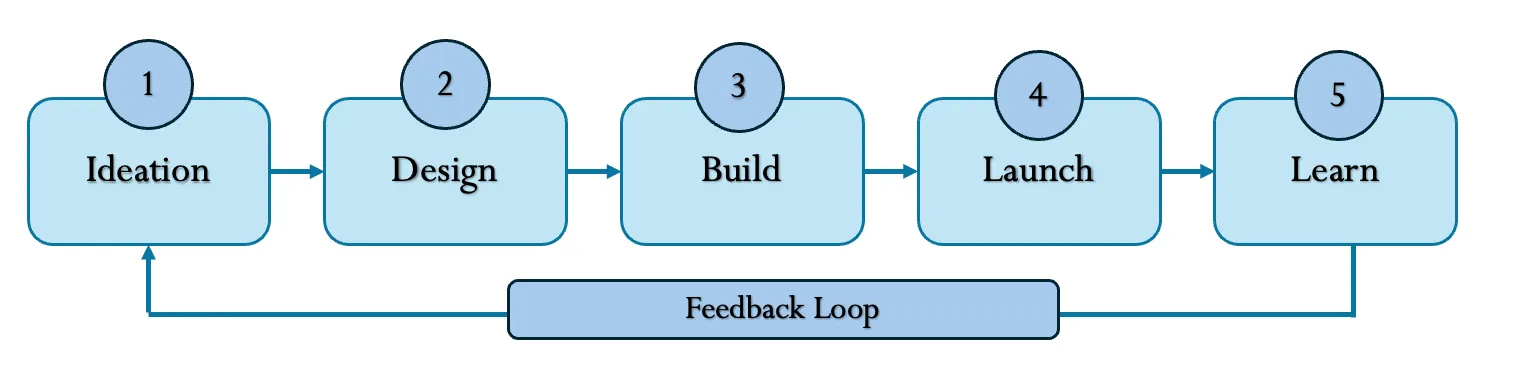
1. Ideation → Generative Exploration
LLMs and copilots are helping teams explore what to build faster than ever. Prompt a model with “How might we reduce checkout friction for Gen Z users?” and it can instantly generate hypotheses, user flows, and even A/B test copy variants.
2. Design → Data-Infused Creativity
Design tools powered by AI (like Figma’s AI assistant or Uizard) now simulate user reactions, predict engagement heatmaps, and propose design alternatives based on prior experiment data.
3. Build → Experiment-Ready Engineering
Modern engineering frameworks integrate feature flags, metric tracking, and causal validation directly into the codebase. This allows for safe experimentation at scale, every rollout is testable by design.
4. Launch → Causal Attribution
Instead of asking “Did this feature correlate with higher conversion?” teams now ask “Did it cause it?” Causal inference frameworks (Propensity Matching, Difference-in-Differences, Meta-learners) help isolate true impact from noise.
5. Learn → Automated Knowledge Loops
Agentic AI systems summarize experiment learnings, identify patterns across experiments, and suggest next actions, forming a self-improving experimentation ecosystem.
The New Product DNA: Core Components
Modern product organizations are evolving from static roadmaps to adaptive, learning systems. At the heart of this transformation lies a new architecture (highlighted below) - a Product DNA where AI, data, and experimentation form the building blocks of continuous innovation.
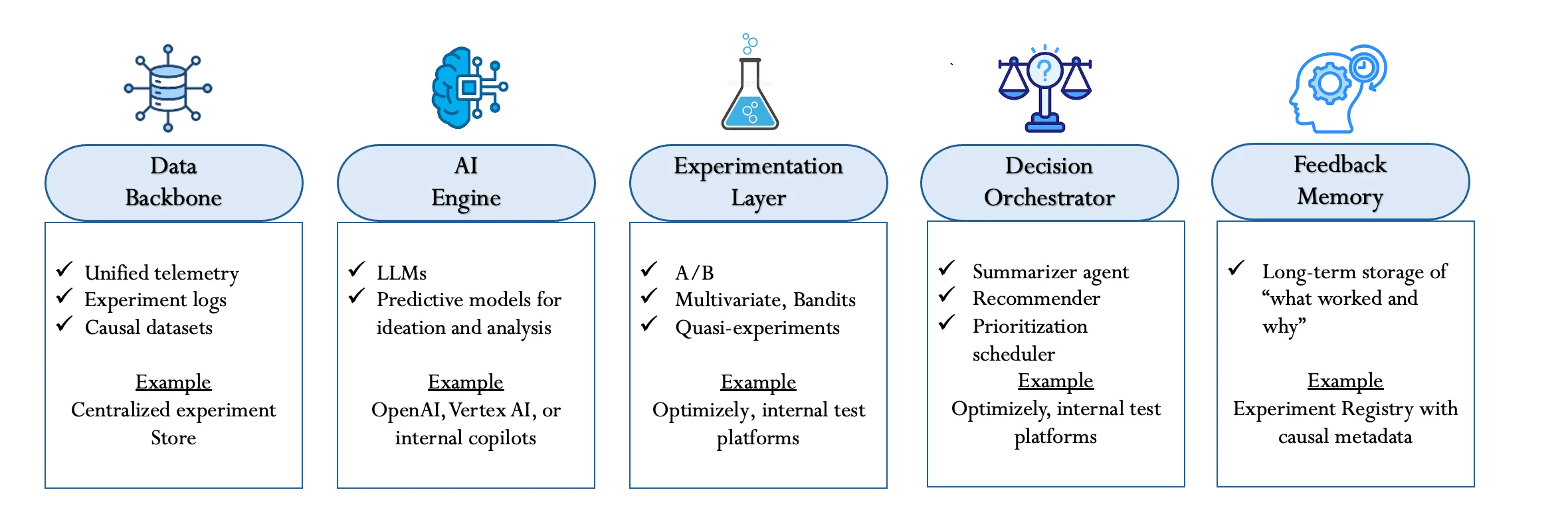
Real-World Example: The AI Experimentation Loop in a Digital Health Platform
Consider a digital health platform for the management of chronic conditions such as diabetes and hypertension. The goal of this product would be to improve daily engagement through encouraging users to record their vitals, adhere to care plans, and take medication as directed. Rather than setting fixed reminders, the product team will create an AI-powered experimentation loop that continuously learns the user's behavior and gradually fine-tunes its interventions in real time.
It begins with a Data Backbone: every interaction is captured—glucose logs, step counts, coach messages, and reminders-unified into one secure telemetry system. This causal-ready foundation connects wearable sensor data, app behavior, and contextual signals like time of day and mood, allowing for cause and effect to be measured with precision.
Through the identification of such patterns, the AI Engine applies LLMs and predictive models to formulate hypotheses. It may identify that users logging meals less than 10 minutes after eating are showing a much higher degree of adherence, triggering new tests of customized notifications or even empathetic message tones for users who display fatigue.
Each of these ideas moves into the Experimentation Layer, where different behavioral nudges are compared in controlled A/B or adaptive tests. For instance, one group receives fixed daily reminders, while another group gets adaptive prompts triggered from sensor data. Effectiveness is determined by metrics such as adherence, the number of app openings, and glucose stability, each automatically favoring better variants through bandit algorithms.
The Decision Orchestrator then summarizes results-for example, "adaptive reminders improved adherence by 8% among evening users" - and schedules the next round of tests. Finally, insights feed into Feedback Memory, a long-term intelligence system that stores metadata on what worked, for whom, and why.
Over time, the platform becomes a self-learning health ecosystem where every interaction reinforces its knowledge of user behavior. The result is more than greater engagement; it's a living, data-driven product that continuously tailors care and fuels innovation.
Next in the Series
Banani’s Next Article: “Rewiring Product Management with Generative AI: From Roadmaps to Deployment.” She’ll explore how generative AI is reshaping product strategy from idea generation to roadmap alignment and real-time user feedback loops.


Nebius at SC25: Building the Neocloud for Enterprise AI
From SC25 in St. Louis, Nebius shares how its neocloud, Token Factory PaaS, and supercomputer-class infrastructure are reshaping AI workloads, enterprise adoption, and efficiency at hyperscale.

Inside SC25: AI Factories From Racks to Qubits
AI didn’t just show up at Supercomputing 2025 (SC’25) in St. Louis—it took over the agenda. From exabyte-scale storage and 800 Gbps fabrics to liquid-cooled racks and emerging quantum accelerators, SC25 made it clear that the next era of HPC is really about building AI factories end to end.
Below is a structured look at the announcements the TechArena team is tracking, organized around the major layers of the stack.
1. Data and Memory Platforms for Agentic AI
The most urgent theme on the show floor: getting more useful work out of every GPU. That starts with memory and data.
WEKA: Breaking the GPU Memory Wall and Storage Economics
WEKA formally took its Augmented Memory Grid from concept to commercial availability on NeuralMesh, validated on Oracle Cloud Infrastructure (OCI) and other AI clouds. The goal is to extend GPU key-value cache capacity from gigabytes into the petabyte range by streaming KV cache between HBM and flash over RDMA using NVIDIA Magnum IO GPUDirect Storage.
The reported gains are significant: 1000x more KV cache capacity, up to 20x faster time-to-first-token at 128k tokens versus recomputing prefill, and multi-million IOPS performance at cluster scale. For long-context LLMs and agentic AI workflows, that means fewer evictions, less recompute, and better tenant density per GPU — directly attacking inference cost structures on OCI and other platforms.
On the hardware side, WEKA’s next-gen WEKApod appliances push the economics further. WEKApod Prime uses “AlloyFlash” mixed-flash configurations to deliver 65% better price performance while preserving full-speed writes, and WEKApod Nitro focuses on performance density with 800 Gb/s networking via NVIDIA ConnectX-8 SuperNICs. Together, they target AI factories that need high GPU utilization, high density, and lower power per terabyte.
VAST Data + Microsoft Azure: AI OS Meets Cloud Scale
VAST Data is extending its AI Operating System into Microsoft Azure. VAST AI OS will run on Azure’s Laos VM Series with Azure Boost, giving customers a unified “DataSpace” global namespace so they can move between on-prem and Azure without refactoring data pipelines.
InsightEngine and AgentEngine let customers run vector search, RAG pipelines, and agent workflows directly where the data lives, and the underlying disaggregated, shared-everything (DASE) design allows independent scaling of compute and storage. The combined effect is a cloud-native AI operating system tuned for agentic AI pipelines, built to keep Azure’s GPU and CPU fleets saturated.
MinIO ExaPOD: Exabyte as a Design Point, Not an Edge Case
MinIO’s ExaPOD reference architecture plants a big flag for exascale AI data. It’s a 1 EiB usable building block (about 36 PiB usable per rack) that scales linearly in performance and capacity. In the reference design, ExaPOD delivers on the order of 19.2 TB/s aggregate throughput at 1 EiB with 122.88 TB drives, around 900 W of power per PiB including cooling, and modeled all-in economics in the $4.55–$4.60/TiB-month range at exabyte scale.
Built on Supermicro servers, Intel Xeon 6781P, and Solidigm D5-P5336 NVMe, ExaPOD is clearly aimed at hyperscalers, neoclouds, and large enterprises that see exabytes as the new baseline for LLMops, simulations, and observability.
2. Power, Cooling, and the Introduction of PCE
As AI deployments creep toward gigawatt footprints, power and cooling have shifted from “facility detail” to board-level design constraint.
Airsys PowerOne and Aegis: Cooling as a Compute Multiplier
Airsys introduced PowerOne, a modular, multi-medium cooling architecture that scales from 1 MW edge sites to 100+ MW hyperscale data centers. It’s tailored for AI and HPC density with a standard cooling stack (CritiCool-X chiller, FluidCool-X CDU, MaxAir fan wall, Optima2C CRAH) and a LiquidRack spray-cooling architecture that can operate in compressor-less modes with dry coolers where climate allows.
Beyond traditional PUE, Airsys is pushing Power Compute Effectiveness (PCE)—a metric that measures how much provisioned power turns into usable compute. The message is that cooling should unlock stranded power and convert it into AI capacity, not just shave a few basis points off energy overhead.
In parallel, Aegis, an affiliated liquid-cooling arm, is being positioned as an agile R&D hub building two-phase CDUs, cold plates, and control systems using rapid 3D manufacturing to keep pace with AI thermal demands.
Schneider Electric and Motivair: Integrated Power + Liquid Cooling
Schneider Electric is leaning into its acquisition of Motivair, blending global power and infrastructure capabilities with more than 15 years of exascale and accelerated-computing cooling experience. The combined portfolio spans chip-level cold plates, rear-door heat exchangers, CDUs, and facility-level power and control systems.
The through-line is that liquid cooling is now being evaluated as part of a full-stack design conversation with power and infrastructure, especially for hyperscale, co-locators, and high-density AI factories where 100 kW-plus racks are quickly becoming normal.
Iceotope KUL BOX: Liquid-Cooled AI at the Noisy, Messy Edge
Iceotope’s KUL BOX brings the AI factory cooling story out of the core data center and into edge environments that were never designed for dense clusters. It’s a compact, liquid-cooled AI inferencing cluster built as a turn-key system: a 24U rack with six Iceotope KUL AI chassis, up to 24 NVIDIA GPUs, top-of-rack switching, and a fully integrated liquid-cooling loop.
The key twist is deployment model. KUL BOX captures almost all of the system’s heat using Iceotope’s precision immersion cooling and rejects it through a separate liquid-to-air outdoor cooler—meaning it can be installed in locations without existing facility water, dry chillers, or traditional white-space infrastructure.
Iceotope highlights several benefits for edge AI and HPC workloads: consistent GPU throughput and reliability from stable thermals, lower energy and cooling overheads, quiet, fanless operation, and a single-vendor solution that bundles rack assembly, fluids, pipework, logistics, on-site installation, and a three-year service plan. Target use cases include telcos and colocation providers, labs running sensitive compute-heavy tasks, and industrial edge deployments with unusual constraints or sustainability requirements.
3. Server and Computing Hardware
On the compute side, vendors largely converged on the same message: more FLOPS per rack, more memory per GPU, and more network bandwidth behind every accelerator.
Dell Technologies: AI Factory Building Blocks
Dell made its AMD Instinct-powered PowerEdge XE9785 and XE9785L servers generally available and introduced the new Intel-powered PowerEdge R770AP. All three are tuned for demanding AI and HPC workloads as part of the Dell AI Factory with NVIDIA.
On the network side, Dell’s new PowerSwitch Z9964F-ON and Z9964FL-ON switches deliver 102.4 Tb/s of switching capacity, targeting dense AI fabrics. Dell also announced integration of ObjectScale and PowerScale storage systems with NVIDIA’s NIXL library, tightening the connection between storage services and GPU-centered inference stacks.
Supermicro, ASUS, Compal, EnGenius: Dense GPU Nodes and Liquid Cooling
Several OEMs showcased how fast they can pack accelerators into standard racks:
Supermicro highlighted Data Center Building Block Solutions featuring NVIDIA GB300 NVL72 systems with 72 Blackwell Ultra GPUs and liquid cooling up to 200 kW per rack. It also launched a 10U air-cooled AMD Instinct MI355X server that claims up to 4x compute and 35x inference performance versus its predecessor.
ASUS unveiled its XA AM3A-E13 server with eight AMD Instinct MI355X GPUs and dual AMD EPYC 9005 CPUs, offering 288 GB of HBM and up to 8 TB/s of memory bandwidth in a modular 10U chassis. The platform complements ASUS’ broader AI infrastructure portfolio, including NVIDIA GB300-based systems.
Compal brought high-density, liquid-cooled SG720-2A/OG720-2A servers supporting up to eight AMD Instinct MI325X GPUs with forward compatibility for MI355X, plus the SG223-2A-I immersion-cooled system that supports up to eight PCIe GPUs in a 2U chassis.
EnGenius, better known in networking, jumped into the server market with modular Intel Xeon 6-based systems. The flagship 4U EAS5210 can be configured with up to eight Intel Arc Pro B60 accelerators for LLMs and AI training workloads, built on an OCP DC-MHS architecture.
Intel Xeon 6: Keeping CPUs Relevant in AI HPC
Intel used SC25 to emphasize that CPUs still matter in HPC and AI workflows, particularly for simulation, pre/post-processing, and orchestration. The Xeon 6 line targets up to 2.1x faster performance on key HPC workloads like LAMMPS, OpenFOAM, and Ansys Fluent, riding on higher memory bandwidth and built-in AI acceleration.
4. Networking for Gigascale AI: Cornelis and Friends
If storage and cooling are about feeding GPUs and keeping them alive, networking is about making the entire AI factory behave like a single coherent system
Cornelis CN6000 SuperNIC: 800 Gbps, Multi-Protocol, AI-first
Cornelis rolled out its CN6000 SuperNIC, an 800 Gbps adapter that brings its Omni-Path architecture into Ethernet for the first time. CN6000 combines ultra-low latency, up to 1.6 billion messages per second, and full 800 Gbps throughput in a single device.
A key design point is “limitless” RoCEv2 scalability. Traditional RoCEv2 fabrics struggle at scale because managing queue pairs becomes memory-heavy and brittle. Cornelis tackles that with lightweight QPs and a hardware-accelerated RoCEv2 In-Flight table that can track millions of concurrent operations while maintaining predictable latency. The CN6000 is fully compliant with Ultra Ethernet and RoCEv2, positioning it as a standards-based path to 800 Gbps Ethernet fabrics that behave more like purpose-built HPC interconnects.
Cornelis is aligning the CN6000 with next-gen Intel Xeon platforms and working with partners like Intel, AMD, Lenovo, Synopsys, Altair, Atipa, Nor-Tech, Microway, PSSC Labs, and SourceCode to build end-to-end 800G solutions and Omni-Path-based switches and directors.
NVIDIA BlueField-4 and Quantum-X Photonics
On the NVIDIA side, BlueField-4 DPUs continued to show up as a central control plane and offload engine for AI factories. NVIDIA highlighted how storage vendors like DDN, VAST Data, and WEKA are adopting BlueField-4 to push storage services closer to GPUs and eliminate bottlenecks.
NVIDIA also spotlighted Quantum-X Photonics co-packaged optics InfiniBand switches, offering 800 Gb/s per port with significantly better power efficiency than traditional pluggable optics. TACC, Lambda, and CoreWeave are among the operators planning to integrate Quantum-X Photonics into their next-generation systems.
5. HPE, National labs, and Exascale Blueprints
SC25 also reinforced how national labs are shaping the AI/HPC roadmap.
At Oak Ridge National Laboratory, HPE and AMD are partnering on Discovery and Lux—two new systems that blend large-scale simulation with AI training and inference. Lux is positioned as a dedicated AI factory for science and energy, while Discovery focuses on high-bandwidth exascale computing.
At Los Alamos National Laboratory, HPE and NVIDIA are collaborating on Mission and Vision, based on the new HPE Cray GX5000 platform and NVIDIA’s latest CPU/GPU and Quantum-X800 InfiniBand technologies. Mission targets national security workloads; Vision will serve as an unclassified AI and science system and successor to Venado.
For the broader ecosystem, these systems serve as reference architectures for how to co-design CPUs, GPUs, networks, and cooling for converged AI plus simulation workloads.
6. Quantum Computing Edges Closer to Production
Quantum wasn’t the main act at SC25, but it was no longer relegated to the demo corner.
QuEra + Dell: Quantum as Another Accelerator Class
QuEra and Dell demonstrated hybrid quantum-classical workflows where neutral-atom quantum processing units integrate into standard Dell HPC infrastructure via the Dell Quantum Intelligent Orchestrator. The point of the demo: treat quantum as a first-class accelerator alongside CPUs and GPUs instead of a separate science experiment.
Quantum Computing Inc. Neurawave: Photonics for Edge AI
Quantum Computing Inc. (QCi) announced Neurawave, a compact, photonics-based reservoir computing system in a standard PCIe form factor. Operating at room temperature, Neurawave targets edge-AI workloads such as signal processing, time-series forecasting, and pattern recognition, offering fast, energy-efficient processing that complements QCi’s quantum systems.
D-Wave: Annealing as an Energy-Efficient Accelerator
D-Wave highlighted how its Advantage2 annealing quantum computer can tackle combinatorial optimization problems with lower energy use than classical approaches — an angle that resonates as AI and HPC operators watch their power budgets tighten.
7. Other Notable Infrastructure Moves
A few additional announcements round out the “plumbing” for AI factories.
Phison introduced new PCIe Gen5 Pascari X201 and D201 enterprise SSDs, tuned for AI training, hyperscale analytics, and mixed read/write inference workloads. They push Gen5 performance to the edge with high throughput and low latency for data-hungry environments.
Hammerspace showcased its AI solution aligned with the NVIDIA AI Data Platform reference design, providing a unified data foundation for RAG workloads, agentic AI pipelines, and hybrid environments. The goal is to give AI workloads instant access to the right data without re-architecting storage.
TechArena Take: The AI Factory Stack Advances
Stepping back from the logos and part numbers, it’s clear that AI is dominating HPC, driven by policy priorities. SC25 felt like the moment AI factories stepped out of the box and began to rapidly progress.
A few patterns stand out.
First, the bottlenecks have officially moved away from raw FLOPS. The interesting innovation is happening around memory hierarchies, storage fabrics, and KV cache management—exactly the spaces WEKA, VAST, MinIO, and Hammerspace are targeting. The vendors that can prove “more useful tokens per GPU per kilowatt” are going to win the next buying cycle.
Second, power and cooling have been dragged into the AI design conversation whether facilities teams are ready or not. PCE, liquid spray cooling, direct-to-chip loops, 200 kW racks, and now sealed, liquid-cooled edge clusters like Iceotope’s KUL BOX are no longer exotic; they’re becoming prerequisites for deploying Blackwell-scale and inference-heavy clusters wherever the data lives. Cooling is quietly turning into a business lever: whoever can convert the most stranded power into usable compute wins.
Third, the network is being rebuilt around AI assumptions. 800 Gbps Ethernet with Ultra Ethernet, RoCEv2 at scale, CN6000-class SuperNICs, BlueField-4 DPUs, and co-packaged optics all point to the same conclusion: traditional data center Ethernet and “good enough” InfiniBand islands won’t cut it at multi-thousand GPU scale. Deterministic, congestion-free fabrics are table stakes if you want agentic AI to actually run reliably.
Finally, quantum and photonics are edging toward “adjacent accelerators” rather than lab toys. They’re not replacing GPUs any time soon, but they’re already being wired into the same orchestration planes and data fabrics as everything else.
Supercomputing used to be the place to talk about peak FLOPS. In 2025, it quietly turned into the place to advance the entire AI factory—from chip to coolant loop to the edge box bolted to a wall in the field.

15 Questions Every Cybersecurity Leader Should Ask on Day One
Stepping into a new cybersecurity leadership role can feel like walking into the middle of a story already in progress. The dashboards are glowing, the acronyms are flying, and everyone seems to have a version of what “secure” really means. Before you start making changes or setting new goals, take a breath. The most effective leaders begin not by talking, but by asking.
The right questions will help you uncover what is really happening beneath the surface: how decisions are made, where risks hide, and how people truly feel about security. Here are 15 questions that can guide you through your first few weeks and help you see the whole picture before you start rebuilding.
1. What does “secure” mean here?
Every organization defines security differently. For some, it is about compliance. For others, it is about resilience or customer trust. Start by understanding what your leadership values when they say something is “secure.”
2. What are we protecting, and why does it matter?
You cannot protect everything equally. Get clarity on the company’s crown jewels, what is truly critical to the business and what is not. Once you know what matters most, your priorities will fall into place.
3. Who really makes the security decisions?
Titles can be misleading. Learn who drives decisions day to day, whether it is a program manager, an architect, or a trusted advisor. Understanding influence is often more useful than understanding the org chart.
4. What keeps our executives up at night?
Security programs thrive when leadership feels confident in them. Ask what worries your executives most and then connect your strategy directly to easing those fears.
5. Where does our data live, and who has access to it?
If you cannot answer this, you cannot secure it. Take time to understand where your data resides, how it moves, and who touches it along the way.
6. What incidents shaped this program’s history?
Every program carries the lessons of its past. Find out what went wrong before, what was learned, and what still lingers as an unspoken worry. These stories reveal more than any dashboard can.
7. How long does it take us to detect and respond to an incident?
Metrics like mean time to detect and mean time to respond are only part of the picture. Ask how those numbers are measured and what slows the process when real incidents happen.
8. How do we decide which risks to live with?
Cybersecurity is a series of trade-offs. Learn how risk is evaluated, who approves exceptions, and how those decisions are documented. You will quickly see whether your organization is proactive or reactive.
9. How do people really feel about security here?
Culture drives outcomes. Talk to engineers, analysts, and business partners. Do they see security as a helpful partner or an obstacle? Their answers will tell you where trust needs to be built.
10. Which tools do people trust, and which do they avoid?
Inherited tools often create as many problems as they solve. Ask your team which systems they rely on and which ones they quietly ignore. Their insights will guide where to invest and where to simplify.
11. Where are we flying blind?
Every program has blind spots. It might be unmanaged assets, unmonitored environments, or third parties no one tracks closely enough. Find those dark corners early and bring them into the light.
12. If the team could fix one thing, what would it be?
This simple question opens doors. It shows respect for your team’s experience and often surfaces the problems that leadership never sees. Listen carefully—this one question can change your roadmap.
13. How do we measure success beyond compliance?
Passing audits is good, but it is different from being secure. Ask what metrics truly reflect resilience, preparedness, and continuous improvement. Those are the ones that matter.
14. What happens when an incident hits?
A plan on paper is not enough. Ask how communication works during real incidents. Who gets the first call? How quickly are decisions made? The answers will show how well your plan translates to practice.
15. Who has the keys to the kingdom?
Privileged accounts, admin credentials, and token signing keys define the boundaries of trust. Know who controls them, how they are protected, and what checks exist. If no one can answer confidently, that is your first red flag.
Final Thoughts
Taking over a security program is not about proving how much you know. It is about understanding the ecosystem you are stepping into the people, the risks, the culture, and history. The best leaders do not rush to fix things. They listen first, connect dots others overlook, and build trust before acting.
Your first few weeks set the tone for everything that follows. Start with curiosity. Ask the questions no one else is asking. When you do, you will not only understand the program you have inherited, but you will also earn the confidence to lead it forward.
Inside Runpod’s GPU Cloud for Long-Running AI Agents
Runpod head of engineering Brennen Smith joins a Data Insights episode to unpack GPU-dense clouds, hidden storage bottlenecks, and a “universal orchestrator” for long-running AI agents at scale.

Achieving HPC Performance with Xeon 6 Processors
In HPC circles, the discussion often revolves around achieving “peak FLOPS.” And while compute is unquestionably important to high performance computing, many HPC applications including scientific simulation, graph analytics, finite element modeling are actually memory-bound. Compute waits for data. That’s where Xeon 6 processor architecture, and it’s support for scalable memory, shines.
I recently met with a national lab team whose spectral simulation scaled beautifully to 128 nodes, but performance flattened beyond 128 because memory bandwidth per core collapsed. Their compute was starving, waiting for data that was slow to arrive. While it would be tempting to throw more flops at the problem, the more elegant solution to their compute constraint was delivery of a balance of compute, interconnect, and memory performance.
Luckily, we’ve designed today’s Xeon CPUs for this balanced performance. In the Xeon 6 processor family, the architecture supports both P-cores (for compute) and E-cores (for throughput) on a unified I/O and memory interface, providing computing environments found in the HPC arena the flexibility they crave. That shared fabric ensures that memory bottlenecks don’t isolate execution to narrow lanes, delivering data effectively to meet compute requirements.
How do we accomplish it? It starts with high throughput memory channels and large cache hierarchies, essentially reducing memory contention within the system. We extend this with a NUMA design, carefully tuned, ensuring that parallel tasks see minimal cross-node memory latency. We layer on low-latency coherence paths, essential to multi-socket configurations found in HPC platforms, and multi-workload support mixing compute, data staging, and I/O including checkpointing and data orchestration. This removes the opportunity for non-compute tasks to gate total workload performance.
The Path Ahead
Do Xeon 6 processors make sense for your HPC configuration? Evaluate your workload requirements, and assess if you’re gated by memory-bound application constraints. I think you’ll discover that the balanced system performance delivered by our latest generation of processors can change the game for compute delivery, making them a solid foundation for HPC deployments.