
Subscribe to Our Newsletter
Read the latest in the world of AI, data center, and edge innovation.
.webp)
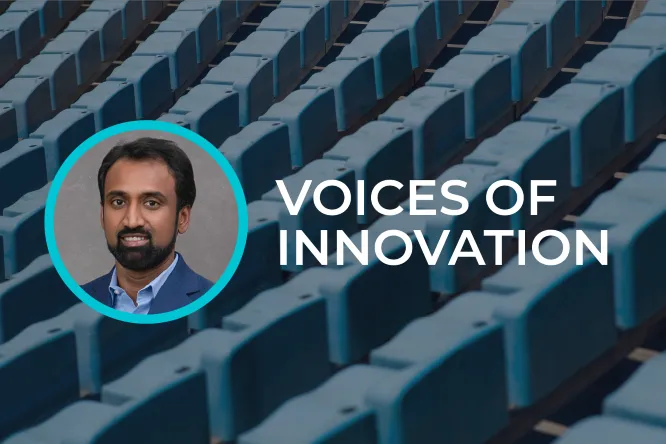
Meet Vivek Venkatesan, one of TechArena’s newest Voices of Innovation. Vivek is a lead data engineer at Vanguard and a senior member of IEEE with 15+ years of experience in data engineering, cloud architecture and applied AI.
I sat down with Vivek to better understand his journey in tech and his unique contribution to the global data and AI community.
A1: I started as a front-end developer on a banking product and was sent to Botswana for an implementation. A critical issue with incorrect ATM transaction data sparked my lifelong interest in data. Since then, I’ve worked across banking, health insurance, healthcare, and financial services. From leading a COVID-19 contact tracing system that protected healthcare workers to cutting wasted cloud costs while enabling AI pipelines, my journey has been about making data both impactful and human-centered. During the pandemic, it was never just numbers on a dashboard, it was lives and livelihoods.
That perspective of empathy continues to shape how I build data systems today.
A2: The Botswana assignment. What seemed like a small data issue, a misreported ATM transaction, showed me how profoundly even tiny errors can affect human lives. That moment pushed me to commit to building systems with integrity, resilience, and accountability. It taught me that data is never just technical; it is deeply human.
A3: In the beginning, I thought innovation meant adopting the newest tool or framework. Over time, I have come to see it as the art of solving real-world problems responsibly and at scale. Sometimes innovation is a bold architectural shift. Other times, it is a simple-but-overlooked fix that unlocks trust and adoption.
To me, true innovation blends novelty with empathy, sustainability, and measurable impact.
A4: Federated and privacy-preserving AI. Organizations need to learn collectively while still protecting sensitive data. This technology allows collaboration across boundaries without compromising privacy. I believe it will be a foundation for scaling AI responsibly in industries where trust and compliance matter most.
A5: I use three filters:
Does it solve a real-world problem?
Can it scale sustainably, financially, technically, and ethically?
Does it lay a foundation for future growth?
If an idea does not meet these, it is usually hype.
A6: That faster automatically means better. In my experience, the innovations that last are built on credibility and trust. A system that people rely on day after day, even quietly, is often more innovative than the flashy tool that grabs headlines and disappears.
A7: They are collaborators. AI can handle repetitive tasks and surface insights quickly, but it is human creativity that frames the right questions and applies judgment. AI amplifies human ingenuity; it does not replace it.
A8: Bridging the trust gap. We already have incredible technology, but adoption often falters when people do not trust it. Building systems that are transparent, reliable, and empathetic to end users will determine whether innovation succeeds.
A9: Photography. Just as I frame a cityscape or a moonrise, in data I try to frame problems from the right perspective. Photography teaches patience, pattern recognition, and the ability to see both details and the bigger picture. These are skills I rely on when solving complex data challenges.
A10: I am excited to share lessons from real-world challenges and to learn from peers who are pushing boundaries in different domains. I hope the audience takes away that innovation is not just about tools; it is about solving problems with empathy, trust, and scale in mind.
A11: Nikola Tesla. I would ask how he balanced bold imagination with the realities of adoption. That tension between radical ideas and practical acceptance is still the defining challenge of innovation today.