
Subscribe to Our Newsletter
Read the latest in the world of AI, data center, and edge innovation.
.webp)
Forty years after a graduate student set out to test whether currents and voltages in a hand-built circuit could obey the rules of quantum mechanics, that same researcher now holds a Nobel Prize and runs a startup focused on a less romantic problem: manufacturing quantum computers at scale. My recent conversation in Santa Barbara with 2025 Nobel laureate John Martinis, co-founder of Qolab, and ZeroPoint’s Nilesh Shah made it clear that quantum’s next revolution will be built in fabs and data centers. My co-host for this Data Insights episode was Solidigm’s Jeniece Wnorowski.
John’s Nobel Prize traces back to a graduate-school question. As a thesis student in the early-to-mid 1980s, working alongside his co-winners John Clarke and postdoc Michel Devoret, he set out to test something foundational: whether a macroscopic variable, say currents and voltages in a circuit, could obey the laws of quantum mechanics. They did. The applied vision came much later.
“It's natural to think about building an electrical quantum computer, because the computers that we use today are based on electrical circuits,” said John.
In 2019, John’s team at Google published results from the Sycamore quantum processor, completing in 200 seconds a calculation estimated to require 10,000 years on classical hardware. Better classical algorithms have closed some of that gap, but the underlying argument holds.
“Some people don’t like the word supremacy, and want to say quantum advantage,” he said. “But I’ve always said supremacy because of this fact. It’s not just a little bit better, but it’s kind of exponentially better in that as you make the systems bigger, it just becomes hopeless to try to simulate that with a regular computer.”
If 2019 settled the science, the next phase is harder. Today’s quantum machines are still hand-built lab instruments.
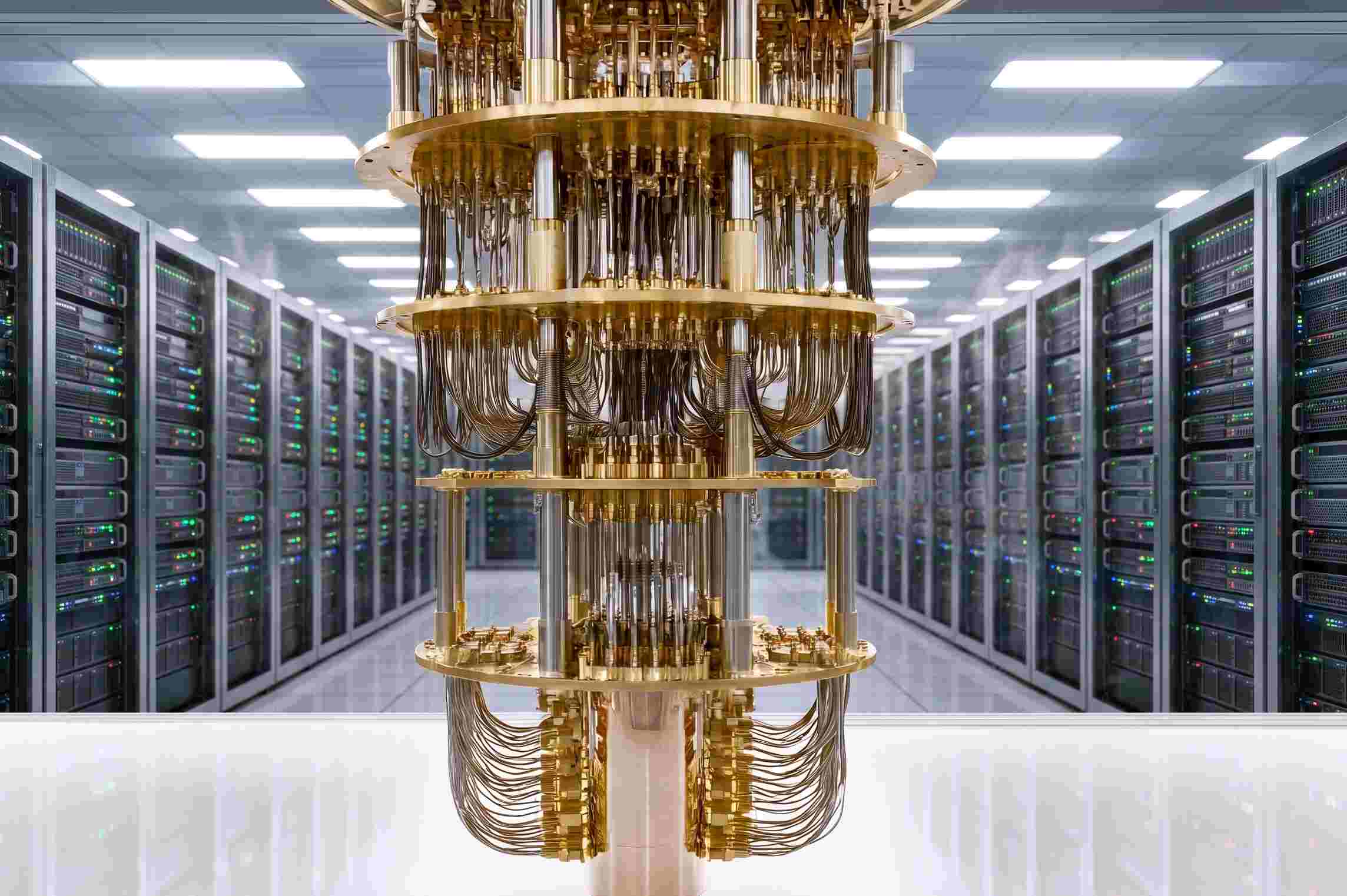
“If you look at the quantum computers now, I call it the golden chandelier,” John said, beautiful in their tangle of microwave components and wiring, but not mass producible.
He sees a clear historical analogue. The plan is to do for quantum what semiconductor manufacturing did for classical computers in the 1950s and 60s: trade the mess of wires for the integrated circuit. To get there, Qolab is working with semiconductor partners on better fab processes and chip-scale packaging. A million-qubit machine built with current techniques would run into the tens of billions of dollars. His bet is that fab-scale manufacturing will bring the cost down the same way it did for chips.
Nilesh pulled the conversation back to today’s AI build-out, where hyperscaler economics are denominated in power. As data center usage is increasingly measured in gigawatts, energy becomes the finite variable. In this scenario, quantum has to earn its place in three ways: improving power efficiency, cutting latency, or unlocking stranded data center capacity in legacy infrastructure.
Nilesh also flipped the dependency most people assume: today, classical infrastructure carries quantum, not the other way around.
“Today it’s actually quantum computing that is leveraging the power of AI and GPUs and CPUs to make these quantum computing elements more stable,” he said, pointing to real-time error correction, system-level calibration, and the digital twins that researchers run alongside live quantum experiments.
One hyperscaler’s multi-million-dollar quantum rentals last year drove a much larger demand for classical compute, in terms of storage, memory and processors needed to feed quantum applications.
Asked when quantum’s ChatGPT-style moment might arrive, John didn’t hedge.
“The standard quote I give is 5 to 10 years,” he said, “with the caveat that people are being very optimistic about the system engineering challenges. We have a little bit of time, but you have to start working on it right now.”
Nilesh framed the wait through the lens of risk.
“The question that people are asking is not should I invest in it, but rather, can we afford not to invest?” He layered in the geopolitical reality, noting that quantum has become a national mandate well beyond the U.S., with sovereign investment accelerating across Europe, Canada, China, and Australia.
When I asked what students considering scientific careers should focus on, John leaned into his role as an educator at UC Santa Barbara. The physics courses are still essential, but engineering courses are just as important: programming, microwaves, optics, and packaging are all core to building real systems, and the field rewards range. He pointed to a former Google colleague who came in with a software background, learned quantum on his own, and “started breaking these limits that everyone put because they made wrong assumptions on it.”
Nilesh, whose own first quantum experiments came through Intel’s open-source qHIPSTER simulator and an early five-qubit IBM machine, agreed.
“It is a multi-disciplinary type of a field,” he said, urging the industry to do a better job of communicating quantum’s career opportunities to students who today gravitate toward machine learning and large language models.
Quantum computing’s first revolution was scientific. Its next, as this conversation made clear, will be built in fabs and data centers. The question is no longer whether the physics works, but rather whether the supply chain and economics can keep pace with what science has proven possible.
For data center leaders, quantum is already pulling demand for classical infrastructure, and preparing for the inflection point, be it across cryptography, materials science, drug discovery, or AI-adjacent workloads, is no longer optional. The timeline may be uncertain, but not the need to start.
Listen to the full Data Insights episode on TechArena.ai.