
Subscribe to Our Newsletter
Read the latest in the world of AI, data center, and edge innovation.

.webp)
Schneider Electric, Motivair by Schneider Electric, and TeraWulf today announced the phased delivery of more than $290 million in AI infrastructure for TeraWulf’s rapidly expanding Lake Mariner data campus, a 180-acre development at the heart of a retired 1,800-acre coal plant that stopped operating in 2020.
Located in Barker, New York, the site houses about 1 million square feet of capacity, which will translate to 750 megawatts of AI and HPC compute once fully developed. About 360 megawatts of Lake Mariner’s capacity is powered and running today. The site never sleeps. It is a 24/7 operation.
“As demand for AI infrastructure accelerates, time to power has become a defining constraint on growth,” said Manish Kumar, executive vice president of Secure Power and Data Centers at Schneider Electric. “Our partnership with TeraWulf establishes a strategic blueprint for pairing on-site power, AI-enabled automation, advanced liquid cooling, and digital intelligence at a legacy industrial site.”
I visited the sprawling Lake Mariner campus last week alongside 30 other journalists from around the globe. We wore reflective yellow vests, hard hats, and protective goggles as we navigated uneven terrain between two partially constructed, mirror-image data center buildings named CB4 and CB5, each one about the size of two Costcos glued together.
Beholding these behemoths, one might never guess that CB4’s first steel pipe went up on January 1, and CB5’s first steel pipe went up on April 1.
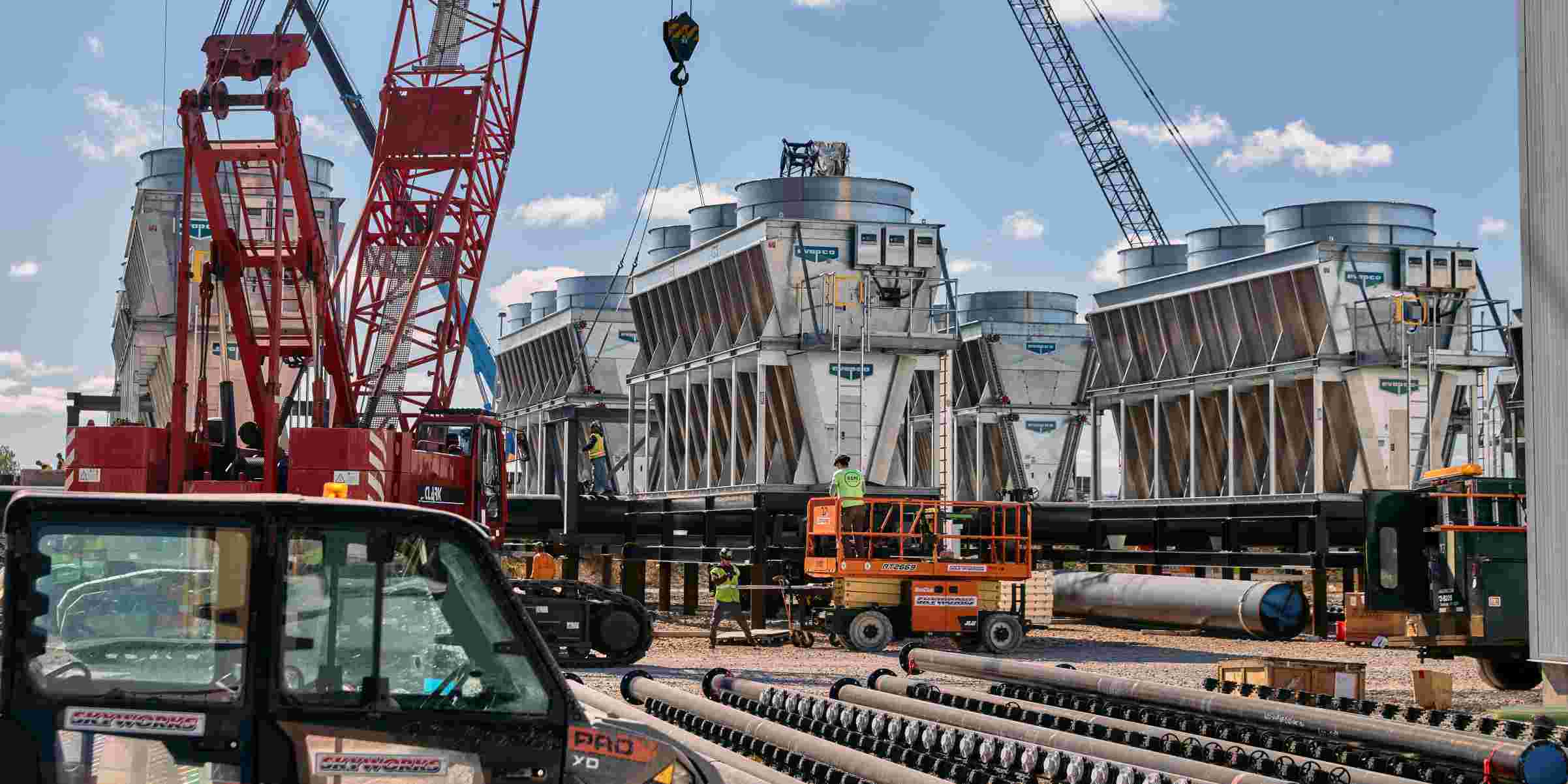
Wind off Lake Ontario kicked up dust along the rocky pathway between the buildings. It was 55 degrees and sunny, cranes towering above, tractors scooting here and there, steel beams reaching skyward. Thick, multicolored electrical cables jutted up from the ground, situated in tidy rectangular rows. Metal chillers coated the rooftops and mazes of thick white piping covered the walls, pipes that will deliver closed-loop liquid cooling to the data halls. The first hall in CB4 is expected to be complete and operational in July; the first in CB5 is planned to power on in October or November.
Having started as a power generation site, Lake Mariner was reclaimed for bitcoin mining and then for AI and HPC compute. The site employs 10 or 15 workers who have been there for decades, as well as children and grandchildren of former coal plant employees, said Sean Farrell, TeraWulf’s chief operating officer.

Unprecedented capital investment continues to pour into HPC and AI data center infrastructure, with aggregate global spending across the full value chain projected to hit roughly $765 billion for 2026 alone.
“The pacesetter at the moment is NVIDIA,” said Marc Garner, who leads Schneider Electric’s cloud and service provider business. “It’s really all about tokenization. How do we take data and systems and turn them into AI output?”
AI workloads will consume 35 to 36 percent of all compute deployed by 2030, Garner said. Schneider tracks roughly 150 neoclouds operating globally, a category that has scaled rapidly since 2023. “The speed at which this is being built out is amazing. Scale at speed. These are the things driving the industry.”
Not far from the bitcoin-hall-turned-café, a sad, beige and brown structure still stands on the site, an old coal power plant turned power substation, only now its connections hook into a regional grid whose mix runs about 89 percent zero-carbon, drawing heavily from hydropower at Niagara Falls and nuclear plants across upstate New York. The original 207-million-gallon water intake that once cooled the coal turbines sits idle. Lake Mariner does not need it.
Our media tour began in an oblong-shaped building that, until a couple of years ago, was filled with rows of 15,000 bitcoin miners. The space has since been repurposed as a café for the 1,800-plus site workers.
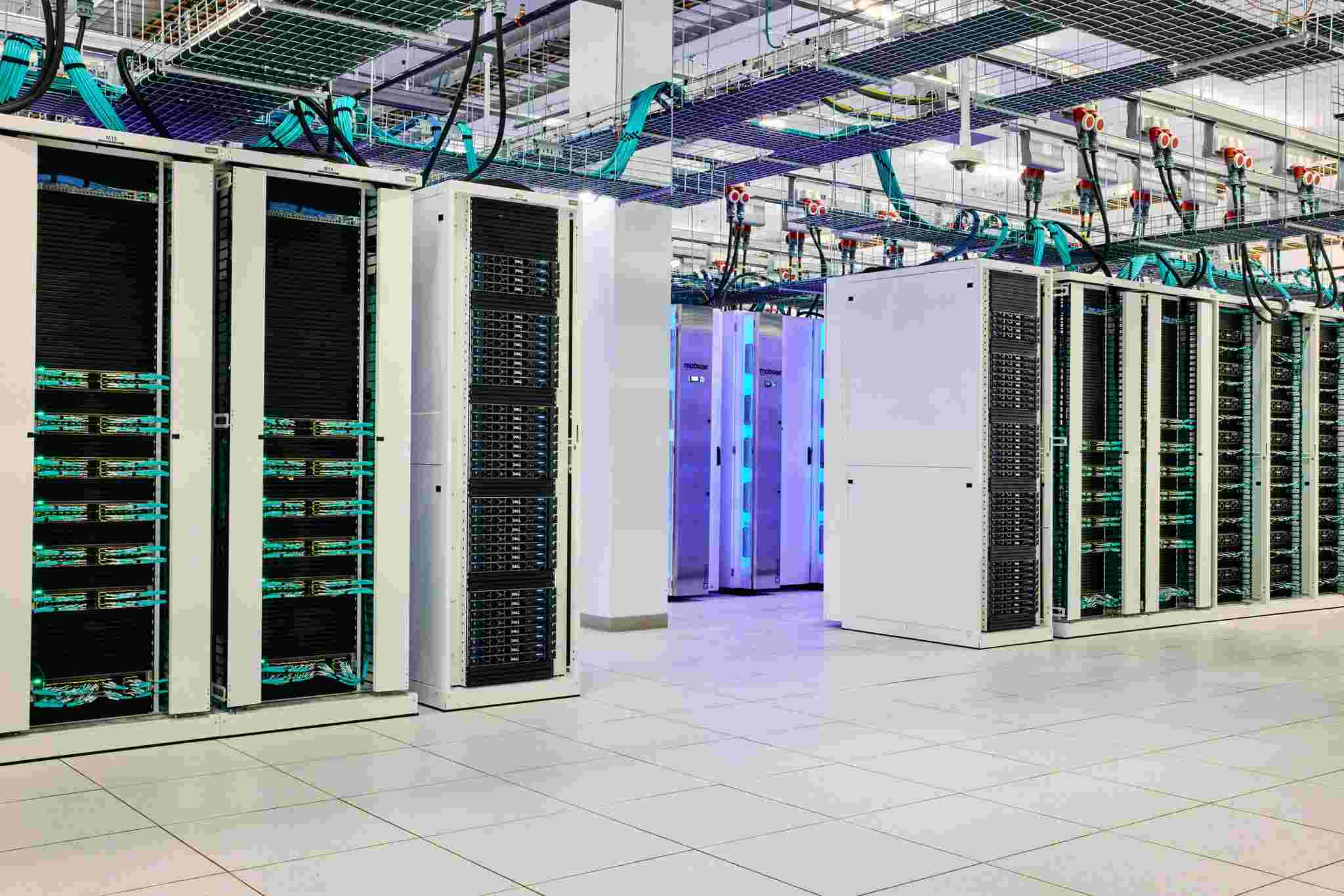
We walked down hallways and peeked into CB1. Through one door, a roomy data hall packed with 16 megawatts of AMD MI300 GPUs quietly operated. “That’s 2,000 pounds of racks,” Farrell said.
The CB1 capacity is leased by Core42, the cloud and sovereign AI subsidiary of Abu Dhabi-based G42, whose American chip access was unlocked through a Microsoft-brokered investment that locked the company into the U.S. technology stack. The arrangement is a working example of what the industry has started calling sovereign AI on managed soil. The UAE gets dedicated, nationally controlled compute. The U.S. keeps Abu Dhabi's spending inside American chips, American jurisdiction, and American export controls. Lake Mariner is one of the places where those two priorities converge.
A short walk down an adjacent corridor opens into the Wulf Den, a 25,000-square-foot, two-megawatt building that started its life as a bitcoin proof of concept and now runs high-density IT workloads cooled by Motivair rear-door heat exchangers.
Fluidstack, the campus’s largest tenant by a wide margin, is backed by Google. Google has guaranteed roughly $3.2 billion of Fluidstack’s leases at Lake Mariner and holds warrants equivalent to about 14 percent of TeraWulf’s shares. CB4 and CB5, the two newest and largest buildings on the site, are custom-built for Fluidstack workloads. Both will run Google TPUs, cooled by Motivair direct-to-chip systems through the closed-loop network piped along the rooftops.
TeraWulf operates roughly 50,000 bitcoin miners across its portfolio of five sites, three gigawatts in total. Lake Mariner is the flagship. Sites in Kentucky, Maryland, and Texas round out the footprint.
The pivot from mining to AI was an exercise in arithmetic. Bitcoin ROI ran roughly a million dollars per megawatt with a 33 to 40 percent yield against cost, an economic structure that demanded constant capital refresh as miner generations turned over. AI and HPC tenants sign long-term leases. They bring anchor revenue. They underwrite the kind of buildout that turns a 25,000-square-foot bitcoin shed into a campus the size of a small city. “We are a colocation provider with power, water, and fiber,” Farrell said. The tenant brings the compute. TeraWulf brings everything around it.
The partnership covers the full electromechanical stack. Schneider Electric is supplying Galaxy VX uninterruptible power systems and Galaxy lithium-ion battery cabinets, integrated into sidecar buildings adjacent to each data center. Motivair contributes Coolant Distribution Units, in-rack manifolds, ChilledDoors, and rear-door heat exchangers. NetShelter racks and enclosures hold the IT equipment. EcoStruxure IT Data Center Expert ties the monitoring and digital intelligence layer together.
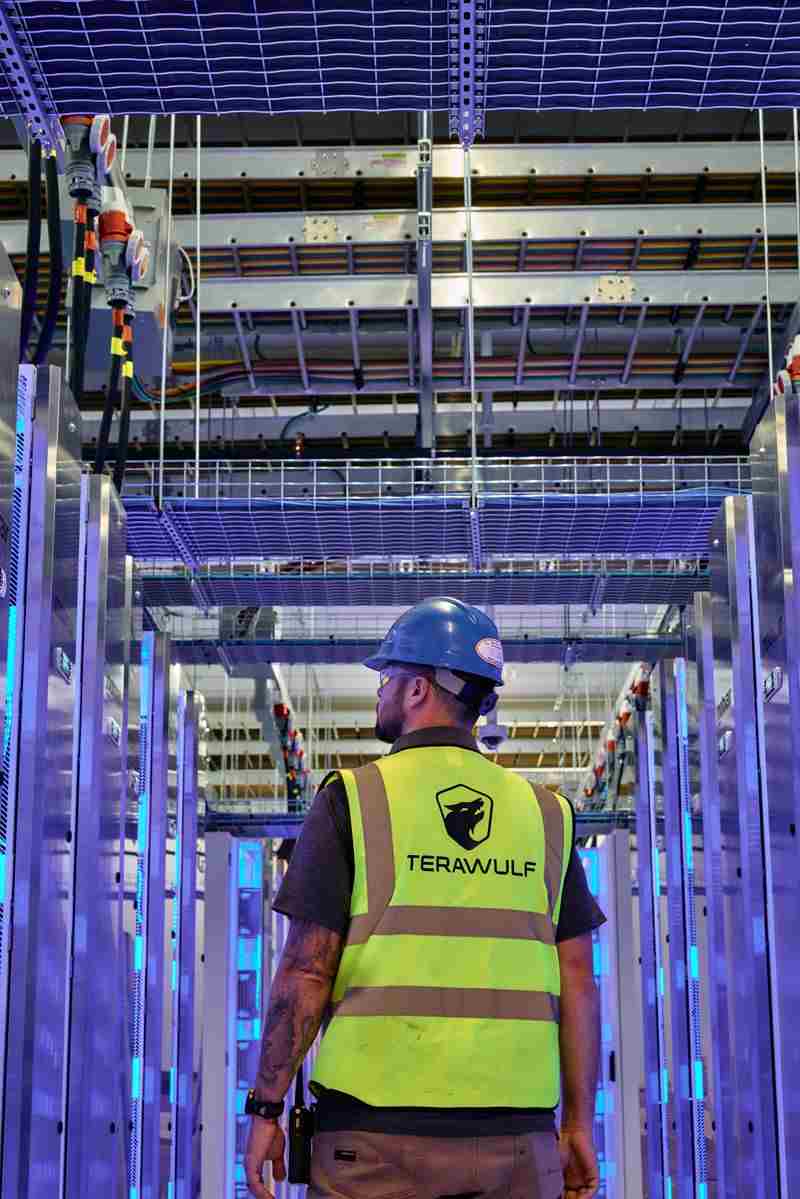
Each CB-series building will host four data halls of about 33,000 square feet apiece, plus a two-story administrative wing. CB4 alone will deliver more than 160 megawatts of IT capacity for Fluidstack across its four halls, roughly 40 megawatts each. The design target is 75 degrees Fahrenheit at the rack. Roughly 70 percent of the heat is removed through water at the chip, and the remaining 30 percent is pulled through the room as residual heat from networking, storage, and adjacent equipment.
The plumbing alone tells the story. Pipes the size of grown men feed each building. Each circular cable bloom rising from the ground holds sixteen separate five-inch and two-inch power runs, each pre-positioned for the tenant’s rack layout. Conduit and copper rise in waves of color: orange, blue, yellow, white, gray. “Our responsibility is for everything going into the building,” Farrell said. “Everything beyond that is the responsibility of the tenant.”
Inside the completed sidecar at CB1, Schneider Electric’s lithium-ion battery cabinets sit in neat formation, ready to carry the data center’s load for up to fifteen minutes if grid power drops on either the A or B feed. Across the way, a near-identical room holds racks of Dell servers fronted with Motivair ChilledDoors. A guide flicked the overhead lights off, and the room filled with soft blue light from the running equipment. The reaction was immediate, audible, a chorus of small sounds from journalists who have seen plenty of data halls but never one quite this lit.
Past the sidecar, the group climbed into the unfinished administrative space of CB4. The walls were raw. The conduit waited. Down the corridor, the first data hall opened onto bare concrete and steel framing. Farrell waved a hand across the empty volume. “This room will be full of Motivair cabinets,” he said. The same building will hold four halls of similar dimension. Data hall four will hand its tenant a customized rack layout designed around their workload before the first GPU arrives.
The economics are not subtle. Building a megawatt of AI compute capacity at Lake Mariner runs $7.5 to $10 million. Eight hundred electricians work the site at any given moment. Sixteen hundred subcontractors carry stickers from past TeraWulf and Somerset projects on their hard hats. “It’s like flair from Office Space,” one of them said.
The biggest bottleneck, Farrell said, is electricians.
Manish Kumar’s keynote at the Schneider Electric Global Media Event in Buffalo framed the moment as the fifth great industrial transformation, on par with the arrival of steam, electricity, factory automation, and the digital era. The earlier transitions took generations. This one is moving in fiscal quarters. A rack housed 10 to 15 kilowatts a few years ago. Today’s high-density racks run above 100. NVIDIA’s roadmap points toward a megawatt per rack inside the decade. The monitoring footprint has expanded in step. Schneider used to instrument a data center with about 10,000 data points. The current generation runs into the millions, monitored and acted on by software increasingly infused with AI agents that can pre-empt failures before a human technician would notice the symptom.
The shape of an AI factory follows the math. Bigger footprints. Higher densities. Hotter chips. Liquid loops where air handlers once stood. Power architectures shifting toward 800 volts at the rack to solve a physical problem, not an efficiency problem, because the cable count needed to feed a megawatt rack at current voltages will not fit. None of this was on a slide three years ago. All of it is on the slab at Lake Mariner now.
“AI has fundamentally changed the data center build equation,” said Gary Lamona, Schneider Electric’s vice president of strategic accounts. “It is an arms race to compete today. Who can bring that compute to market fastest?” Average labor costs across U.S. data center construction have climbed 30 percent year over year. The supply of skilled mechanical service technicians has tightened in step with electricians. Schneider’s pitch in this environment is simplification. The company estimates it supplies roughly 90 percent of the infrastructure that goes into a modern AI data center. Customers consolidate vendors, shorten supply chains, and trade dozens of bilateral procurement relationships for a single technology partner.
Of all the slides shown in Buffalo last week, the most newsworthy may have been the ones the audience did not see coming. Tuan Huang, who leads innovation for Motivair and Schneider’s broader cooling business, walked the room through a case study his team had not previously published.
The setup was simple. Take three data center architectures: a traditional air-cooled facility, a current generation AI data center, and a near-future AI data center built around NVIDIA’s Vera Rubin platform. Run the same 100-megawatt workload through each. Compare the results in Dallas and in Paris.
The Dallas numbers landed hard. A traditional air-cooled 100-megawatt data center consumes more than 400,000 cubic meters of water per year. That is the equivalent of 966 households’ annual usage, or 161 Olympic swimming pools. A current-generation AI data center cooled with evaporative towers consumes 382,000 cubic meters. A Vera Rubin data center built around closed-loop liquid cooling drops the number to 197,000 cubic meters, equivalent to 474 households’ annual consumption.
The Paris numbers, run against a milder climate, tell the same story in smaller print: 80,000 cubic meters for traditional, 108,000 for current AI, 51,000 for Vera Rubin.
Tuan’s framing cut through the headline anxiety that has dogged the industry for a year. “Liquid cooling to the chip is required,” he said. “Water consumption to cool a data center is a choice. It’s a technology choice. And it’s a geographical choice.”
He reached for an analogy his family and friends could follow. Air-cooled data centers are old Volkswagen Beetles, engines hot and exhaust pouring into the air. Liquid-cooled data centers are modern cars with radiators. The radiator transfers heat. No water leaves the loop. “Zero water is needed to cool a car today,” he said. “That’s the same for AI data centers.”
The case study went further. Operators can choose to evaporate water at the cooling tower to push efficiency higher, or they can reject heat through dry coolers and high-efficiency chillers and consume almost no water. In Dallas, the no-water option costs about 5 percent more in energy consumption. In Paris, the difference vanishes. The mechanical efficiency of an AI data center, even one that uses some water, runs 70 percent better than a traditional air-cooled site at the cooling equipment level. The total facility power efficiency improves by 11 percent. That 11 percent flows directly back to AI workloads.
Lake Mariner runs the no-water playbook by design. “We do not use any water during normal operations,” Farrell said. “We have a closed-loop cooling system.” The fluid inside each loop carries a 30 percent glycol blend and a corrosion inhibitor. Each CB-series building holds roughly 300,000 gallons of charged fluid. Once filled, the loop runs without replenishment for 10 to 15 years. The bitcoin operation on the property uses a similar closed-loop strategy, and the legacy coal-era water intake remains untouched.
The cooling architecture matters beyond water. Motivair’s CDUs, in-rack manifolds, and rear-door heat exchangers were originally engineered to cool supercomputers, and the company’s installed base now includes six of the world’s ten fastest. Aurora, Frontier, and El Capitan all rely on Motivair technology. El Capitan still holds the top spot.
By the time the second half of 2026 closes, CB4 and CB5 will both have data halls online and the first Google TPUs landing inside. TeraWulf has begun the engineering work to push the campus from 750 megawatts toward a full gigawatt of capacity.
AES is building an 800-acre solar farm adjacent to the site that will connect into the same substation and feed both the campus and the broader grid. The team is already exploring heat reuse opportunities. The roads on the property carry the names of TeraWulf operators and former coal plant workers.
Manish Kumar’s framing of the moment lingered after I left Buffalo. AI demands more, he said, and Schneider delivers. He meant infrastructure. He could have meant time, capital, electricians, water, and patience. The Lake Mariner project bundles all of it onto a single piece of land that has now hosted three eras of American industry without going dark in between.
A coal plant powered a region for decades. A bitcoin operation kept the lights on through a cryptocurrency boom and bust. An AI factory is rising now on the same earth, cooled by closed loops, fed by hydropower, monitored by software that did not exist when the original turbines spun their first revolution.
The next chapter of American AI infrastructure will not be built on greenfield. It will be built on sites like this one, where the grid interconnection is already paid for, the workforce is already trained, the community already understands what a heavy industrial neighbor looks like. Lake Mariner is the proof of concept. The clock is the constraint.