
Subscribe to Our Newsletter
Read the latest in the world of AI, data center, and edge innovation.
.webp)
“As Jensen Huang of NVIDIA put it, it was a match made in heaven,” said Rich Whitmore, President and CEO of Motivair by Schneider Electric, sitting across the table from me at a brewery in Buffalo, New York.
He was referring to Schneider Electric’s purchase of 75% of his liquid cooling company for $850M cash in February 2025. (The remaining 25% is set to follow in 2028.)
“We were under (Schneider Electric’s) watchful eye and we didn’t know it,” he added. “I think they had identified us as an important part of their product portfolio. They acquire best of breed, the elite. We were just kind of doing our thing and growing our business.”
Rich smiled, quick to pivot the credit for Motivair’s success to his father, its founder. Graham Whitmore emigrated from Europe to Buffalo in 1977 to open the U.S. factory of the cooling company that employed him. He founded Motivair eleven years later, in 1988. Its original focus was manufacturing industrial refrigeration and process cooling systems, but the firm evolved over the decades into a prominent global leader in high-efficiency liquid cooling and thermal management for AI and high-performance computing (HPC).
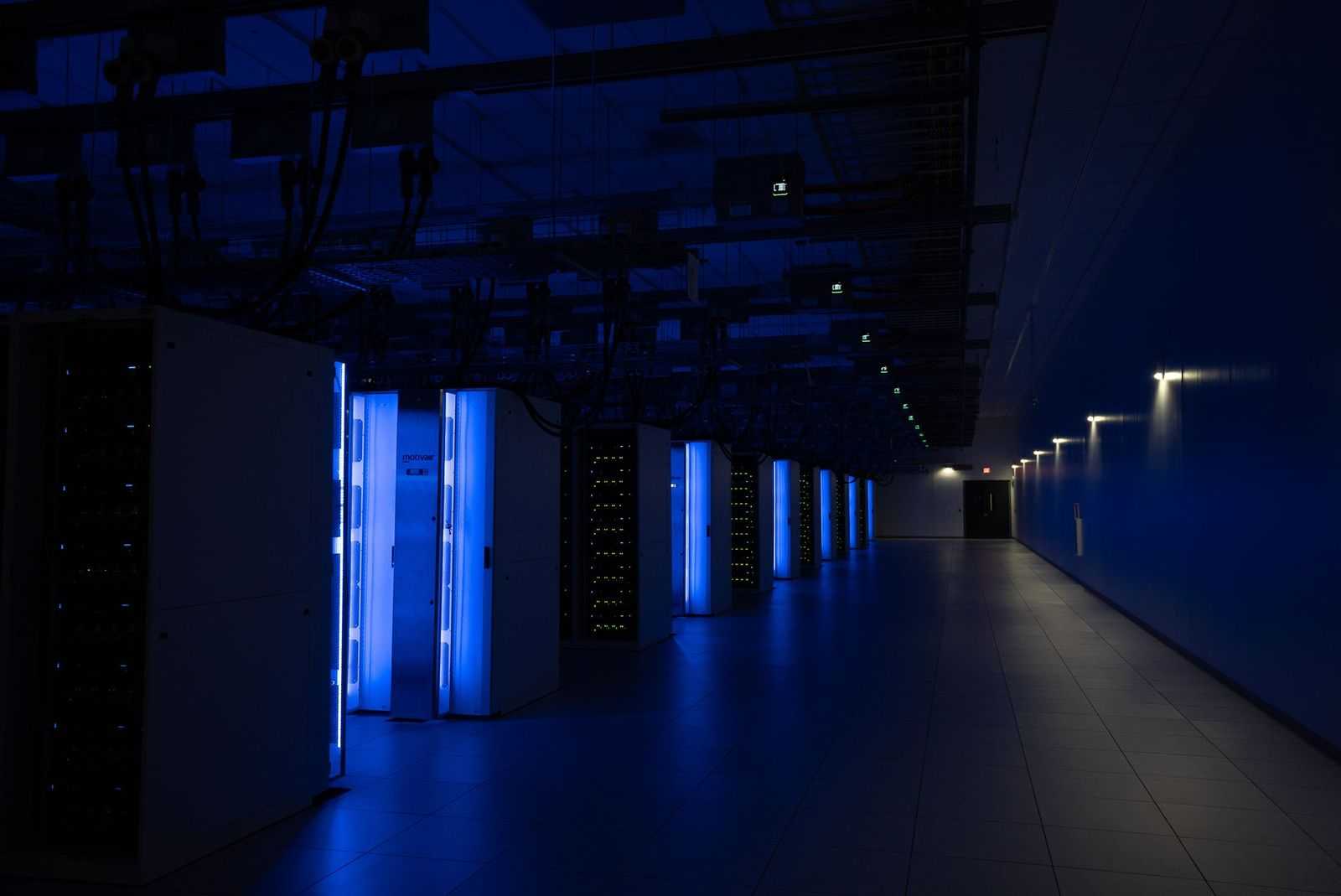
Today, Motivair by Schneider Electric’s technology is installed in six of the top 10 supercomputers in the world, including the three fastest in the U.S.: Aurora, Frontier, and El Capitan. El Capitan is currently the fastest supercomputer on Earth.
“It wasn’t really me, it was really my father,” Rich said, noting that Graham passed away in 2015. “He was like the American dream. Came over here with nothing, literally nothing, no family, no relatives, just he and my mother. They built this company from the ground up, no debt, never took a loan from the bank. They were not wealthy people. I grew up in a very humble household and I’m just privileged to still be connected to this business. I love what I do.”
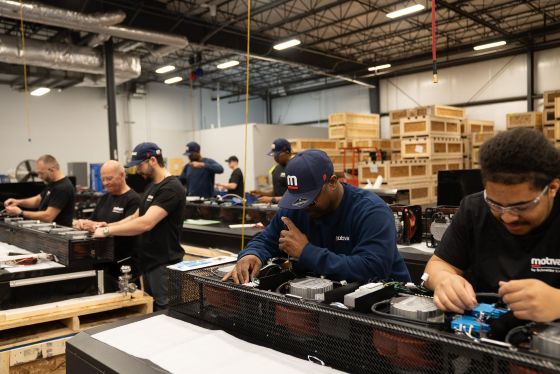
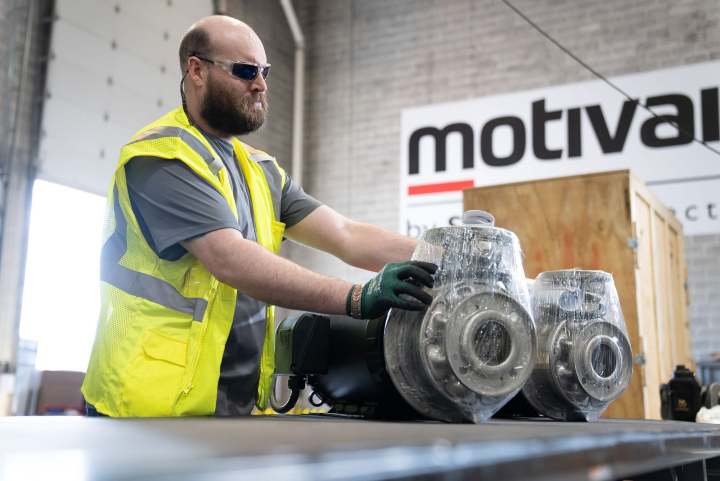
Earlier that day, Rich led a group of 31 journalists, including myself, on tours through Motivair by Schneider Electric’s headquarters and a manufacturing facility. We got an up-close-and-personal look at their chillers, their heat rejection technology, and we saw the end-to-end assembly and testing of one of their Coolant Distribution Units (CDUs), which reminded me of the size of a skinny vending machine. We also got a look at the inner workings and assembly of their ChilledDoor, a kind of door-slash-refrigeration unit that delivers scalable cooling directly at the rack level.
So there we were, Rich and me, sitting at a table on the second floor of a Buffalo wing joint-slash-brewery for a 30-minute interview after a long day of touring. All around us, other Schneider execs chatted with reporters from around the globe. Downstairs, tables full of journalists snacked on nachos and Buffalo wings, drank Diet Pepsi, and tap, tap, tapped on their keyboards, transferring their scribbled notes from the tour that day into their laptops.
When Graham and his wife, Sylvia, settled in Buffalo in 1977, they quickly recognized that the city was rich in resources: sheet metal work, engineering, and thermal transfer.
“There’s several heat exchanger companies that are based here. But the best resource in this town is the people,” Rich said. “Hardworking people, salt of the earth, that we could not have built our business without. Buffalo is a special place.”
Asked what makes it special, he said Buffalo “has all the great features of a big city in a small, close-knit community where people generally get along."
Rich studied mechanical engineering at Rochester Institute of Technology with a focus on heat transfer.
In the early 2000s, as a young mechanical engineer, Rich expressed interest in working for the family business. Graham’s answer was pragmatic.
“He said, ‘Look, to be fair, I’d rather have you go and cut your teeth somewhere else rather than on my dime. But there’s an opportunity here.’”
It was a sales management position.
“My father told me, ‘I’m happy to give you this opportunity, but it’s sink or swim. You can’t be here and not be great at what you do because you carry my last name, and that’s it. If it doesn’t work out here, I still love you. You can go and work somewhere else.’”
“Fortunately for me, I think I turned out doing okay,” Rich said.
The mechanical engineer in Rich likes to see how things work. Having watched his father grow Motivair Corporation from the time he was a child, he knew a little bit of what he was signing up for when he joined the company.
“So, my father actually emigrated to the United States in 1977 to start a business in the U.S., but he was working for a company,” Rich said. “He wanted to open up a factory in the U.S., and it was for computer room air conditioning. And that’s what he’d done his whole career. He was young at the time. And when he started Motivair originally, he said, ‘I don’t want to be in the computer room air conditioning business anymore.’”
When Rich joined the business, Motivair was doing a lot of critical process cooling. They had some data center work, but also hospitals, factories, anything that needed to operate 24/7.
“Around the time of the dot-com boom, we started getting drawn into the data center industry,” he said. “So, I’ve been kind of a part of this evolution for really my whole career. The world was a lot different then. Data centers were a lot smaller. There was always a level of criticality, as you can imagine. But over the course of my career, because of the level of resiliency and redundancy that we were producing with our products, like this robust nature design, we were very quickly drawn into some very critical cooling applications in data centers. So, it didn’t take long for me to start getting these gray hairs coming through.”
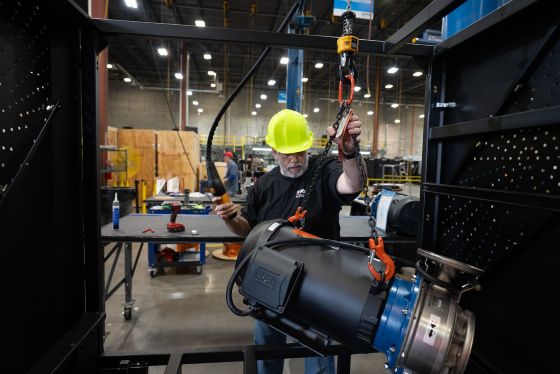
Modern liquid cooling technology like Motivair’s sits as a sort of sidecar to GPUs, both to chill and to reject heat. In large part, this tech was developed by Motivair in collaboration with leading supercomputer manufacturers, Rich said.
“What you’re seeing commercialized now, a lot of that hard work was really done more than a decade ago, and we were right smack in the middle of that,” Rich said. “Cray was acquired by HPE, but Cray was the innovator and they invented the first supercomputers. Those systems that we developed for them were cooling computers that were harder to develop than putting somebody on the moon."
Knowing what he was working on was making a difference gave Rich a deep sense of purpose, he said.
“Nobody had been doing this at the levels that we’d been doing it, nobody,” he added.
The unassuming CEO has a unique way of translating tech jargon into plain English.
“We don’t make power, we just move it,” he explained. “The power comes into the data center, and 100% of that power that goes into that server is converted to heat. If you have a gigawatt campus, for example, okay, there’s some power that goes to lighting and desktops and things like that. But the vast majority of that power goes into the servers. They create tokens, and the output, the result, is heat.”
When Motivair engages with a customer, staffers can speak knowledgeably and with credibility about any part of the project that they’re working on, Rich said.
“We speak this language fluently. It makes us hugely valuable to customers, regardless if they’re buying everything in the (Schneider Electric) portfolio or just parts of it.”
During a cooling panel discussion earlier that day, Rich described Motivair’s role with customers as “the adult in the room,” the engineer guiding hyperscalers and AI factory developers onto a safe path through liquid cooling deployments most have never attempted at scale. Motivair was cooling 400-kilowatt racks ten years ago. Today’s industry-leading commercial deployments run 150 to 200 kilowatts. The company has been ahead of the heat for longer than most of its customers have been in the data center business.
When Motivair was acquired, the company had its choice of suitors.
“We could have chosen a dozen other companies,” he said. “We chose Schneider because we saw where they were in the industry, and, more importantly, we felt that their culture aligned with ours. They had a commitment to people, a commitment to innovation.”
Rich stayed on as CEO and the company headquarters remain in Buffalo.
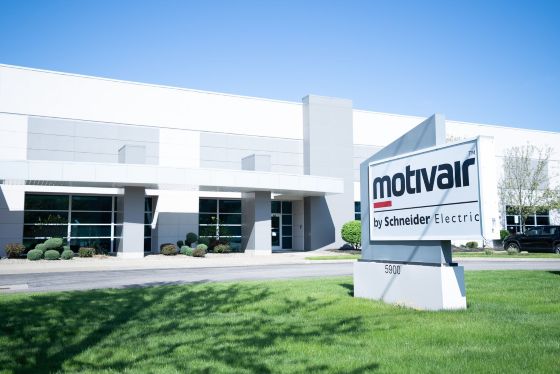
“This was a highly strategic move,” he said. “This liquid cooling expertise was the one thing that Schneider was missing. And so by acquiring us, there is no other company that has this portfolio of products. And it doesn’t mean that we roll into every customer and force-feed them this end-to-end solution. Yes, we’ve got very large customers that benefit from that, but it means that when we engage with a customer, we can speak knowledgeably and with credibility about any part of the project that they’re working on. And even if they’re not using Schneider product X, Y, or Z, we understand what they’re using and how it can impact Motivair’s cooling systems that are there, or the chiller plants that are outside.”
For Motivair Corp., Schneider Electric brought something the company could never have built quickly: scale.
“We’ve been very, very pleased with the integration and becoming part of Schneider,” Rich said. “We benefit from the vast resources of Schneider Electric, supply chain expertise, global factories. What we’ve been able to do is start taking our products and industrializing them so they can be built in other Schneider Electric factories. We actually have footprints in a large factory in Bangalore, India, and the cooling factory outside of Venice, Italy in a town called Conselve. So there’s actual Motivair product rolling off those lines today to support different regions.”
I’d wager that no one realized, even at the beginning of 2025, how rapidly AI would advance from training to inference to agentic, or how much cash the hyperscalers would start to dump into new data centers and AI factories to meet the dizzying demand.
The numbers behind that boom are staggering, and they flow directly through companies like Motivair. Goldman Sachs' structural modeling puts baseline global AI CapEx at $765 billion for 2026. The Big Five alone are projecting capital expenditures of $660 billion to $690 billion this year, with Amazon expected to spend $200 billion on infrastructure expansion and Alphabet more than doubling its 2025 spend to roughly $175 billion. Every one of those megawatts needs a CDU.
“If you were to take every megawatt of power that data centers are bringing online, every megawatt needs a CDU connected to it, period,” Rich said. “That’s just the way it is. For every GPU or, let’s say, server that’s got several GPUs in it that’s going out, every single one of those needs to be connected to a CDU.”
Graham Whitmore did not live to see any of this. He passed away in 2015, a decade before Schneider Electric’s $850 million purchase, before Jensen Huang would call the deal a match made in heaven, and before his son would lead a flock of journalists through the company he built from nothing.
Toward the end of our conversation, Rich came back to his father one more time. He sat with the line for a moment before he said it.
“That’s like a true American success story that probably should be talked about more.”
I thought about that line as I got on a plane home the next day. Graham arrived in Buffalo in 1977 with Sylvia at his side, no relatives waiting at the gate, and a factory to open. Today, a large majority of the gigawatts of AI infrastructure being stood up around the world move through a coolant distribution unit that traces back, in an unbroken line, to that arrival.