
Subscribe to Our Newsletter
Read the latest in the world of AI, data center, and edge innovation.

.webp)
What does success look like when you’re no longer willing to trade everything for it? I spent the past year figuring that out.
After more than 30 years in big tech, I took my first real professional break. Time away gave me something I hadn’t had in decades: space to reset my professional priorities. I had the rare chance to look at my career from the outside in. I saw the toll that constant travel, relentless pace, and “always on” expectations took on my health, my family, and my sense of joy. I heard similar stories from other women at this stage of life, accomplished leaders quietly questioning how they want work to fit into their 50s and beyond. That reflection clarified what I want more of, and what I’m no longer willing to trade away.
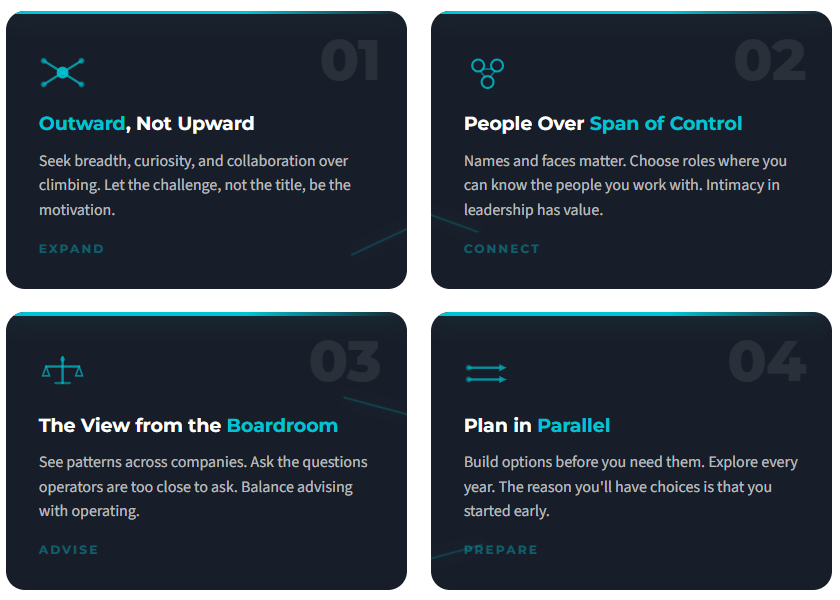
Now I’m back, and I’ve rewritten my playbook. As I settle into my new roles as a TechArena co-founding Advisor and a board member at Jabil (NYSE: JBL) and Dycom Industries (NYSE: DY), I’m using four principles as my blueprint to redefine ambition, leadership, and impact in this next season of my career.
My old motto for evaluating new opportunities was: “If I’m equal parts excited and terrified, I’m in the right place.” That mindset pushed me to take on more, seek bigger roles, move up. It’s a good mindset for climbing the ladder.
Today, upward is no longer my goal. It’s outward. I want to learn about new technologies, experience new industries, work alongside people who genuinely inspire me. Fancy titles, large salaries, and big organizations offer perks and prestige, but they require significant sacrifices, too, and I’ve gotten clear-eyed about what I’m willing to trade.
Success now means surrounding myself with people I admire and trust, building collegial relationships, and letting curiosity pull me forward instead of fear or competition pushing me from behind.
I miss the days of truly knowing my team. When you’re managing thousands of people, the organization becomes distant. You lose names. You lose faces. I thrive on personal relationships and a leadership style that prioritizes developing the individual along with delivering results.
This isn’t about only working with small companies. Jabil and Dycom are anything but small. It’s about choosing roles where I have a fighting chance to know the people I work with, personally and professionally. There is value in intimacy in leadership.
The same principle drives how I want to operate inside organizations: with quick, clear decision-making and less bureaucracy. So many companies talk about moving fast, making mistakes, learning, and course correcting; few have the tolerance when it comes down to it. I want to empower innovation through genuine, empathetic support: identify decision-makers up front, keep them to a minimum, and push decisions down the leadership stack whenever possible. Learn together, try again quickly, give people time and grace to take risks.
Patience, applied at scale, is its own kind of leverage.
I got my first taste of board service in 2022, when I joined the Board of Directors at Lattice Semiconductor. I stepped down in 2024 in accordance with my role at AWS, but the experience reframed how I think about contribution. Going deeper into a company as an advisor or director has been more rewarding than I expected.
The role of an advisor or director is fundamentally different from operating, and that difference is the point. Operators live inside their company’s day-to-day. Boards and advisors get the rarer privilege of seeing patterns across companies, asking the questions executives are too close to ask, and helping decide which bets are worth making. After 30 years on the operator side, I have a lot of pattern to draw from, and I’m finding I’m just as happy being the right hand to a CEO I admire as I am leading a business of my own. That balance has become essential to my career satisfaction, and I believe it makes me a better, more insightful executive in any seat.
This is why I joined TechArena Advisory as a co-founding Advisor, and why I said yes to Jabil and Dycom. Each is a company whose mission, leadership, and trajectory I genuinely admire, and each gives me the chance to contribute at the level where strategy is set.
I’m a big believer in exploring new opportunities every year. Interview internally or externally to keep your network, interviewing skills, and resume fresh. Explore new industries, expand your skills, and add to your network of experts and mentors. Cultivate areas for future growth.
A mentor of mine taught me that I should look for a new role every three to four years. The first two years, you are ramping to performance and autonomy. The third year, you are mastering the work. By the fourth or fifth year, your company is getting the benefit of your mastery, but you may find your upward—or outward—development has slowed. By planning three to five years ahead and exploring options, you’ll have many more opportunities waiting when it’s time to move, planned or unplanned.
The reason I had options when I needed a break is that I’d been quietly building them for 30 years.
At the end of each work week, I always took a mental check: had I moved forward, backward, or stayed in place? If I hadn’t made real progress in a few months, I committed to creating a change. Stagnation will kill innovation, in business and in life.
The harder question is how to make that change. For me, it comes down to setting boundaries and being willing to accept the trade-offs that follow. I put my career on pause when my twins were born. I did it again last year. I was fortunate to be able to do so, and the trade-offs were real both times.
If you’re quietly asking yourself these same questions, know that you’re not alone. I’d love to hear your thoughts on sabbaticals or career shifts. What lessons have guided your own professional journey? Has your perspective changed in your 50s?
Best,
Raejeanne — together, we win.