
Subscribe to Our Newsletter
Read the latest in the world of AI, data center, and edge innovation.
.webp)
The open hardware community’s flagship week produced a 256-CPU rack built for AI agents, a new inference accelerator, an 800-volt AI factory already under construction and a cooling paper with a blunt message for all of them: the industry adopts a new method only after the old one fails, and it pays for the delay.
At the 2026 OCP Global Summit in San Jose, the open hardware community moved its focus to readiness. The specifications, supply chains and skills for the next infrastructure transition are being built now, before a chip or a power grid makes them mandatory.##SUBHEAD##
The clearest sign of that shift came from the processors that feed AI accelerators rather than the accelerators themselves. Arm’s Mohamed Awad told the Monday keynote audience that AI agents, which he described as software that automates a person’s intent, now run as dedicated virtual machines with their own CPUs, memory and security isolation.
“An agent is just a virtual user. A virtual user who never sleeps,” Awad said.
Awad split the market into three CPU jobs: the head node feeding the accelerator, the cloud-native CPU serving users and managing infrastructure, and the agentic CPU acting as the virtual user. Arm published a white paper on CPU performance for agentic AI, developed with Fujitsu, Meta and OpenAI, and asked the OCP community to treat it as a starting point.
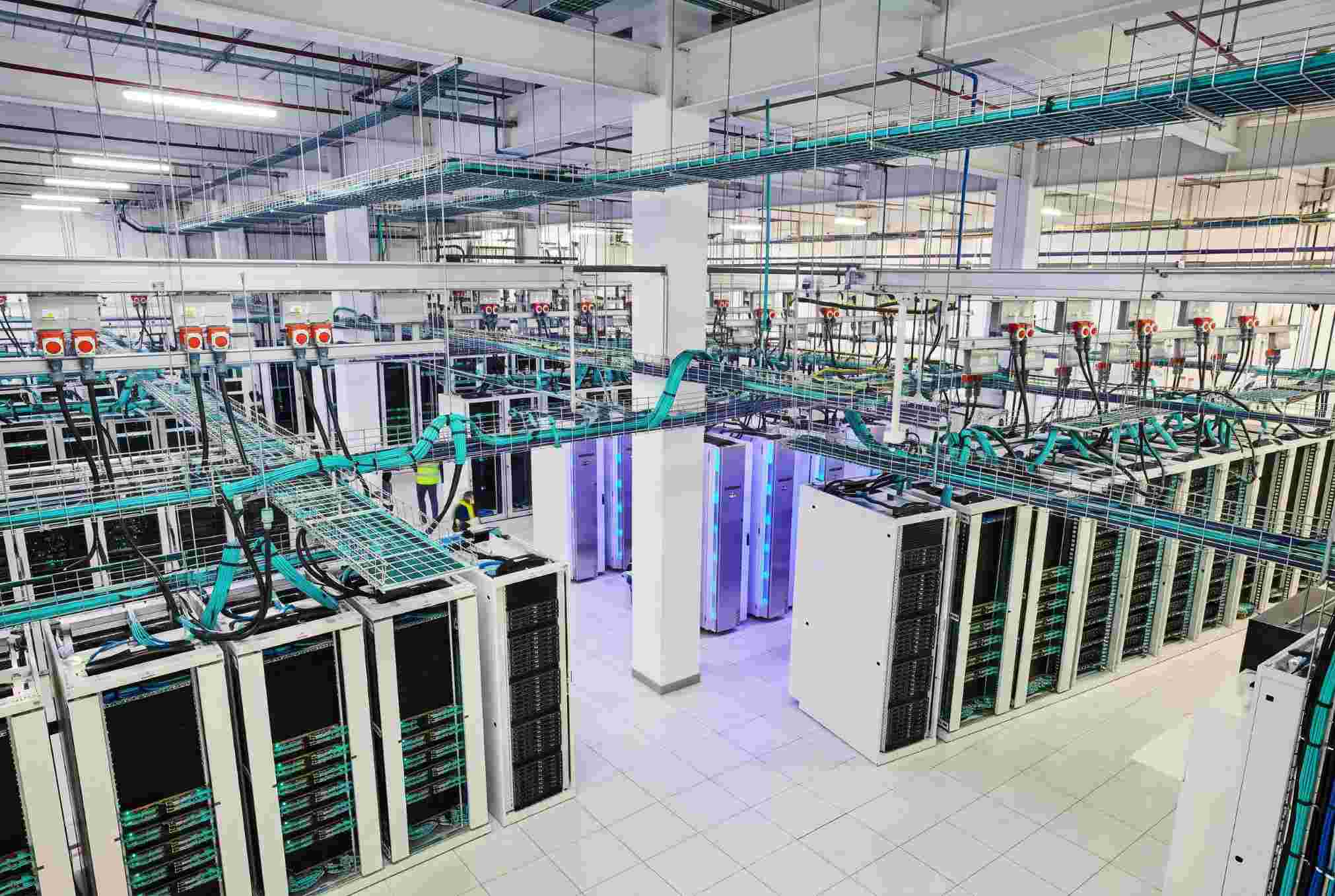
NVIDIA’s Ian Buck answered with hardware. The company’s Vera CPU rack, an MGX design holding 256 liquid-cooled CPUs, is now shipping, and NVIDIA contributed its third-generation MGX 1.2 rack architecture to OCP, down to the compute tray, busbar and quick disconnects. Buck said NVIDIA designed Vera for single-threaded speed because a gigawatt-scale factory of GPUs should not wait on a CPU.
AMD’s Lisa Su made the same point from the other direction, introducing Helion, an OCP-based rack for agentic AI that customers can configure CPU-only or with GPUs, with partner systems planned for November.
Accelerators still had their moment. Microsoft unveiled Maia 300, an inference accelerator the company says delivers up to 7x the rack-scale token throughput of Maia 200, with multi-gigawatt deployments planned from 2027.
Broadcom’s Asad Khamisy gave the summit its most direct example of an industry extending an incumbent technology rather than replacing it. Five or more hyperscalers now run Ethernet scale-up networks in production, he said, and the OCP Ethernet for Scale-Up Networking effort, ESUN, has grown to more than 175 organizations since its launch at last year’s summit.
On cabling, Khamisy said new modulation can double bandwidth inside a rack while holding copper’s 2-meter reach, which he described as extending the life of copper in the rack. Beyond a thousand XPUs, he said, operators are moving to hybrid designs with copper inside the rack and optics across racks. Microsoft’s Reynold D’Sa pointed to the Optical Compute Interconnect MSA, the first optical specification for multi-rack scale-up systems.
Power delivery produced four new specifications in a single week. Buck said the first 800-volt DC AI factory, built by Visionbay on the OCP standard now in development, cuts copper use by about 45% and scales from today’s 100-kilowatt racks toward 1 megawatt. Microsoft contributed its Mt. Diablo 800-volt architecture, which separates power conversion from the compute rack, to OCP at versions 0.7 and 1.0, and D’Sa said the company is working with utilities on a common grid-interface specification released last month.
Google, Meta, Microsoft and NVIDIA published an OCP Grid Resilience Specification that targets restoring near-full load within two seconds of a grid disturbance. Meta described its Prometheus cluster in Ohio, spanning more than 30 structures, and said prefabricated fabric buildings can bring capacity online in three to five months. OCP CEO George Tchaparian said the summit drew roughly 15,000 attendees with a 3,000-person waitlist, and the foundation expects more than 700 member organizations by year-end.
Each of those announcements reads differently against “Thermal Boundaries in AI Infrastructure,” the 104-page paper OCP published on Oct. 12. Its authors, from Promersion, Oracle, Meta and Avayla, name the dynamic that governs cooling transitions: a new method is adopted only when the current one can no longer do the job, because each new method brings a dependency the ecosystem has good reason to defer. The paper calls this the least-disruption law.
The cost of that deferral has a name, too. When air cooling hit its physics limit on the hottest accelerators, the paper says, “only a thin layer of downstream vendors was ready for it,” and the supply of cold plates, manifolds and coolant distribution units fell short. The authors call the resulting bill “preparation debt.”
Single-phase cold plate has a physics limit of its own, projected near 4,000 watts for a reticle-class die, and the paper notes that frontier package power doubles roughly every two years. The authors’ answer is not a successor technology but a toolbox: air, cold plate, immersion, two-phase methods and microfluidics kept ready, interoperable and matched to the heat, the site and the moment.
The keynotes supplied the toolbox in practice. Microsoft’s third-generation Mt. Atlas heat exchanger nearly doubles cooling capacity in the same footprint, and the company now runs multiple independent water loops at different temperatures for a mixed fleet of liquid-cooled and air-cooled racks. NVIDIA’s MGX 1.2 contribution standardizes flow rates and quick disconnects so that OCP members can build compatible parts, Buck said, and he said assembly of the Vera Rubin compute tray dropped from 90 minutes to one minute.
The thermal paper closes with a line that could serve as the summit’s thesis: “Air cooling is finishing. Liquid cooling is just beginning. No single method wins, and the only real choice is to be ready for all of them.”
We read this year’s OCP Global Summit as the week the community put the paper’s advice into practice. The 800-volt specification, the grid resilience specification, ESUN and the OCI MSA all arrived before the parts that depend on them have shipped at volume. That timing is the readiness the paper asks for.
The paper also names the gap that the keynotes left open. Commissioning, the step between building a multi-technology thermal system and trusting it with production load, now binds schedules as tightly as physics binds the chip, and the paper says no single vendor owns it. Operators should expect the next round of OCP work to land there, at the seam between the server and the building, where the paper says the lasting value sits. The companies that prepare that seam now will deploy when the next wall arrives. The rest will scramble, and the paper has already shown what the scramble costs.