
Subscribe to Our Newsletter
Read the latest in the world of AI, data center, and edge innovation.
.webp)
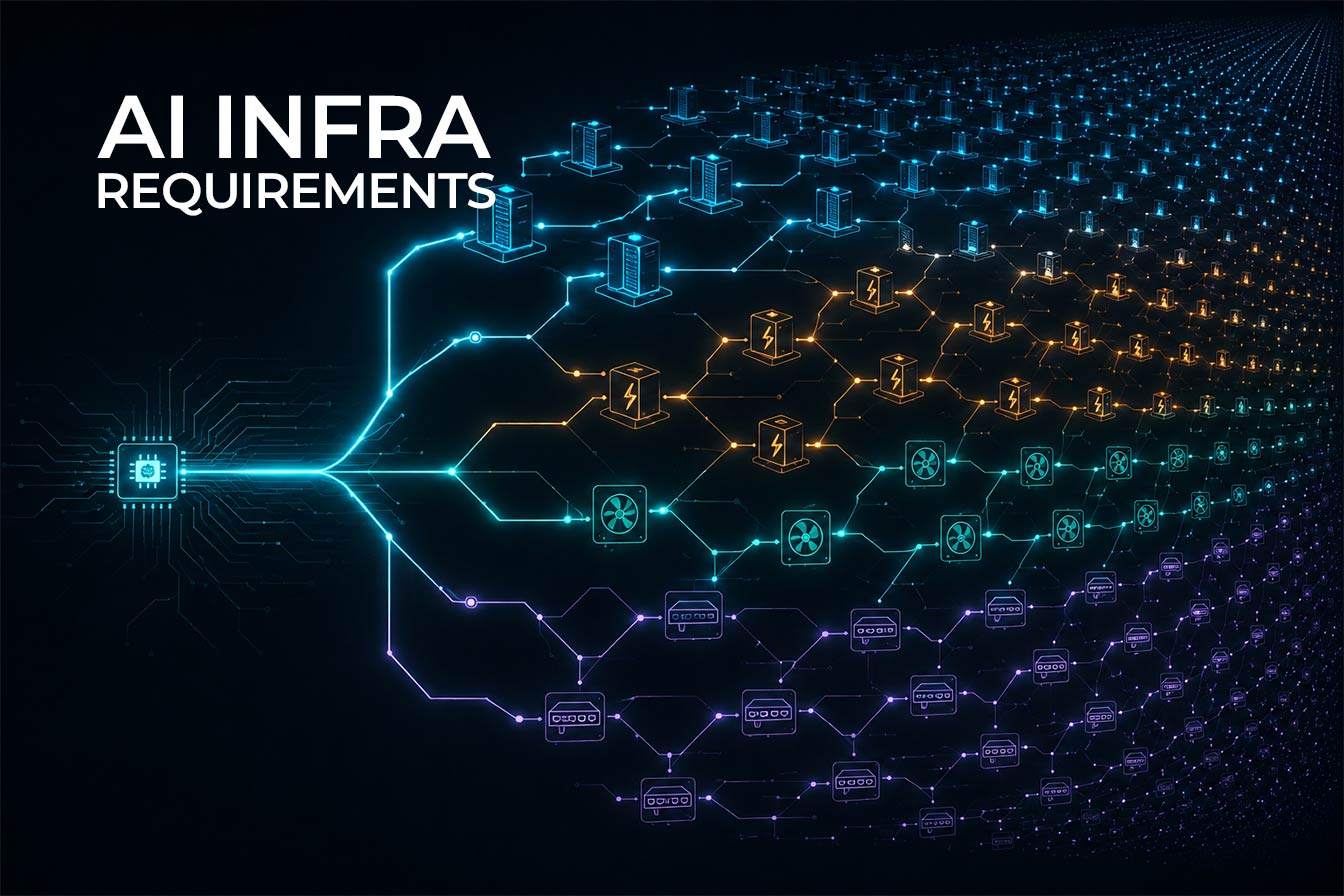
With AI deployments fundamentally changing the data center infrastructure conversation, firmware has become the trusted source of telemetry driving automated decisions across workload placement, power balancing, cooling optimization, and predictive maintenance.
For our last 5 Fast Facts Q&A in our summer series on AI infrastructure requirements, we sat down with Colin Brix, vice president of marketing at AMI, a Lattice Company, to discuss the critical role firmware plays in managing the components of the AI stack and AMI's emphasis on an open, unified codebase. Here's what we learned.
Q1: AMI's firmware runs from the BIOS and BMC on a single server up to fleet-level management across a data center. What are operators asking that firmware to do today that they weren't a year ago?
A: A year ago, operators were primarily focused on server health, uptime, and traditional infrastructure monitoring. Today, AI deployments have fundamentally changed the conversation.
Operators are demanding much deeper visibility into the resources that directly impact token production and infrastructure efficiency. That means granular telemetry around GPU performance, accelerator utilization, power consumption, thermal behavior, interconnect performance, and rack-level power dynamics. They are also asking firmware to provide increasingly sophisticated power management capabilities, allowing them to optimize performance-per-watt without sacrificing workload throughput.
Just as importantly, operators are looking for real-time data that can feed higher-level AI factory orchestration systems. Firmware is no longer just reporting health status. It's becoming the trusted source of telemetry that drives automated decisions around workload placement, power balancing, cooling optimization, and predictive maintenance.
In short, firmware is evolving from a management layer into a data and control layer for the AI factory.
Q2: The boot-to-workload chain is invisible when it works and everything when it doesn't. Where in that chain do AI deployments most often run into trouble?
A: The biggest challenges emerge at the intersection between rapidly evolving hardware and increasingly complex software stacks.
AI infrastructure combines CPUs, GPUs, accelerators, networking fabrics, storage, power systems, and orchestration software that often come from multiple vendors. Any mismatch in firmware versions, configuration settings, security policies, device initialization, or hardware inventory can create failures that are difficult to diagnose and expensive to resolve.
What makes AI environments unique is that issues that might only affect a single server in a traditional environment can impact an entire training cluster. A node that is misconfigured, running an inconsistent firmware level, or failing attestation checks can prevent thousands of GPUs from operating at full efficiency.
This is why operators place such a premium on consistency and trust throughout the boot chain. Secure provisioning, firmware integrity validation, hardware attestation, and automated fleet-wide lifecycle management have become critical because the cost of a single misbehaving node is dramatically higher in an AI environment.
From AMI's perspective, success comes from creating a trusted and repeatable path from power-on to productive workload execution across the entire fleet.
Q3: MegaRAC OneTree pulls management of compute, power, cooling, and networking into one open codebase across different silicon. What changes for an operator when those sit in one place instead of separate tools?
A: MegaRAC OneTree's unified codebase enables operators to focus on maximizing the token output of their AI factory instead of spending time maintaining dozens of independent management stacks.
With separate management domains, every platform, subsystem, and vendor often comes with its own codebase, update cycle, security process, telemetry model, and operational workflow. That creates tremendous operational complexity and introduces risk every time an update or security patch must be deployed.
A unified codebase changes that equation. When a vulnerability is discovered or a feature enhancement is required, it can be addressed once and propagated consistently across the heterogeneous fleet. Operators gain a common operational model regardless of whether they're managing compute nodes, accelerators, power infrastructure, cooling systems, or networking equipment.
Equally important, every component speaks the same language. Telemetry becomes normalized, automation becomes simpler, and fleet-wide optimization becomes practical. By creating uniformity across a heterogeneous AI factory, OneTree removes friction from daily operations and allows teams to focus on efficiency, performance, and scale rather than infrastructure complexity.
Q4: As fleets scale into AI factories, what has to be true about telemetry and automation for one team to actually run tens of thousands of nodes?
A: At AI factory scale, telemetry must be accurate, consistent, and synchronized.
Decisions about workload placement, power allocation, thermal management, and capacity planning are only as good as the data feeding those decisions. Accurate telemetry combined with precise timestamps is essential because operators are increasingly correlating events across thousands of systems simultaneously.
Beyond accuracy, standardization and unification become absolute requirements. AI factories are inherently heterogeneous environments containing compute platforms, accelerators, networking fabrics, power infrastructure, cooling systems, and storage resources. If each subsystem exposes different management interfaces and telemetry formats, automation becomes fragile and operational overhead grows exponentially.
Successful operators require systems that expose common telemetry models, common APIs, and common lifecycle management processes. Only then can automation safely aggregate fleet-wide data, identify anomalies, trigger remediation actions, and maintain optimal performance at scale.
The reality is that nobody manually operates a 50,000-node AI factory. The telemetry and automation architecture must be designed so the fleet effectively manages itself, with humans focusing on policy and optimization rather than individual device administration.
Q5: What does an operator need from the control plane to be able to promise a predictable and trustworthy cost per token?
A: A predictable cost per token begins with complete visibility and control across the entire AI factory.
Operators must continuously optimize compute utilization, networking efficiency, power consumption, and cooling performance on a second-by-second basis. Any blind spot or inconsistency directly affects infrastructure efficiency and drives up token costs.
To achieve this, operators need a control plane that is fast, reliable, and unified. They need a single operational framework that provides trusted telemetry, consistent automation, and coordinated management across all infrastructure domains. Their engineering teams should spend their time optimizing AI production rather than reconciling conflicting data sources or maintaining multiple management stacks.
Trust is equally critical. The control plane must be built on a common hardware root of trust that validates systems from initial power-on through workload execution. Operators need assurance that every system in the fleet is running authorized firmware, trusted software, and verified hardware.
Ultimately, predictable cost per token requires three things: trusted data, automated optimization, and strong security. AMI's role is to provide the foundational management infrastructure that enables all three at AI factory scale.