
Subscribe to Our Newsletter
Read the latest in the world of AI, data center, and edge innovation.

.webp)
Niklas Panten and his team at etalytics keep track of how much energy their software saves per customer and site across global deployments. Watching the numbers climb unifies the team around the company’s purpose, Panten said.
Founded in 2020 as a spinoff of Niklas’ PhD research at the Technical University of Darmstadt, etalytics builds AI software that orchestrates the cooling, heating and power systems in data centers and factories so they use less energy.
Panten, co-founder and CEO of etalytics, built his PhD on a mix of mechanical engineering, computer science and energy science. He helped develop the ETA Factory, a full-scale research factory TU Darmstadt opened in 2016 to test energy efficiency on working production lines.
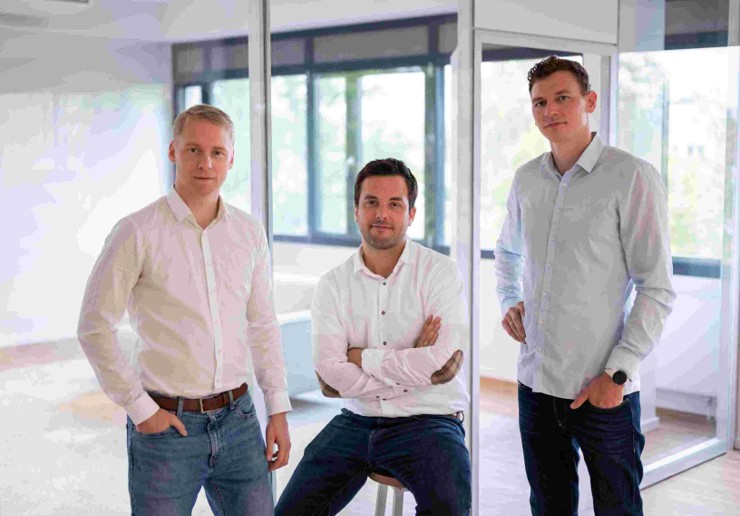
His research group spent more than 10 years analyzing and optimizing energy systems in manufacturing plants. Its partners included Bosch, Volkswagen and Mercedes, along with chemical and pharmaceutical companies. The researchers used AI to run cooling, heating, ventilation, on-site generation and batteries more efficiently, work Panten said began before the AI boom.
“In our research, we found almost 50% in savings in those systems,” he said.
Two research projects at the factory, PHI-Factory and SynErgie, ran from 2014 to 2018 and produced the first ideas and prototypes of etaONE, the platform etalytics sells today, according to the company. Thomas Weber, who co-founded etalytics with Panten and is now its chief strategy officer, worked on his PhD in the same lab. The founding team, which includes CTO Björn König, came together in 2019.
“(This work) came from personal passion; I was a controls engineer and I started on power converters,” he said. “I found out that we can… make (power converters) much more efficient. But even if you have the most efficient power converter, if you have the component that has a power converter in there, and it’s not operating efficiently, you’re still losing energy.”
The same problem repeated one level up. “And then looking at the component, you can optimize the component, but if it’s not optimized or orchestrated in the system, then you’re still losing energy,” he said.
That finding is the basis of etalytics: to run at its most efficient point, a whole system has to be orchestrated. In a data center, Panten applies it to cooling “from the rooftop to the server room.”
In 2020, Equinix asked the team to take its approach to data centers.
“They basically asked us, ‘Hey guys, we’ve seen your potential here, can you transfer this to data centers?’” Panten said.
At Equinix’s FR6 data center in Frankfurt, etaONE cut the energy used for cooling by 900 MWh a year and avoided 240 tonnes of CO₂ emissions a year, with a payback of less than 12 months, according to etalytics.
The company kept its industrial work. At Merck’s headquarters in Darmstadt, etaONE cut the electricity used for cooling by an average of 21%, in a project coordinated by TU Darmstadt’s ETA research group. At the Stellantis paintshop in Rüsselsheim, Germany, it cut ventilation energy use by more than 60%, in a project with the university.
“Cooling is a cross-sectional technology,” Panten said. “So, the same cooling equipment that we deploy for data centers, you will find in automotive, chemical, pharma, logistics, especially cold logistics, food processing.”
The company’s etaONE platform sits on top of a data center’s building management system (BMS). It streams the cooling plant’s telemetry into a physics-based digital twin of the equipment, calculates new set points every two to three minutes and writes them back to the BMS.
“We don’t rip and replace anything, we just add on top,” Panten said.
At Telehouse’s Frankfurt campus, digital twins of the cooling towers showed their performance declining. etalytics traced the decline to fouling, a buildup of deposits on the towers’ heat exchangers that reduces how well they shed heat. A heat wave was approaching, and Telehouse moved its maintenance up. Panten said the predictive maintenance product grew out of checking etalytics’ own models against the plant.
“As soon as we saw deviation, we knew it’s not our models that deviate, it’s the physics that change,” he said.
Over an assessment from April 14 to Aug. 5, 2026, etaONE adjusted the cooling tower outlet temperature and the recooling pump flow. One unit used 10.4% less electricity, and etalytics projects 497 MWh in annual savings across five units. The project won the Infrastructure Sustainability Award at the Platform Global Awards 2026.
Panten said etalytics chose physics-based models over reinforcement learning so operators know why the system makes each change.
Panten said energy efficiency is crucial in an industry constrained by power.
“Everyone is looking for more megawatts, so when you make megawatts available from cooling, you can put them in compute,” he said.
He pointed to research from the International Energy Agency, which projects that well-documented AI use cases could save more than 13 exajoules of energy by 2035, equivalent to 3% of global final energy consumption, if barriers to wider adoption are overcome.
etalytics opened an office in the San Francisco Bay Area in May 2026, and Panten is now based in Menlo Park, California.
Microsoft’s venture fund, M12, led an investment in etalytics in 2025. This year was the company’s first time attending Yotta, and Panten said it will have a booth next year. In October, the company plans to launch etaONE IQ, an assistant for operators’ daily work, at an event with Microsoft and NVIDIA during San Francisco Tech Week. Panten said etalytics’ AI will also move onto the coolant distribution units that serve AI factories.
We see cooling orchestration as one of the fastest ways for operators to free megawatts for compute without waiting on the grid. The physics-based approach matters as much as the savings, because operators of mission-critical sites need to understand every change an AI makes before they trust it.