
Subscribe to Our Newsletter
Read the latest in the world of AI, data center, and edge innovation.
.webp)
For decades, the industry has named walls: the memory wall, the compute wall, the network wall, the cooling wall, the data wall. The list keeps growing. This week, more than 6,000 people converged on Las Vegas for Yotta 2026 and unpacked the wall beneath all of them: power. Without power, none of it functions.
Across three days, the builders, suppliers and founders on Yotta’s stages and on the expo hall floor made the case: The industry can deploy only as much AI as it can power, so every gain in compute, cooling, storage, networking and I/O now counts in tokens per second per watt.
Varun Sivaram, CEO and founder of Emerald AI, told the Crusoe Main Stage audience on Tuesday morning how much of the AI factory capacity planned in the United States will lack grid power to run it.
“If I put some numbers to it, between now and 2028, the United States seeks to connect something like 70 gigawatts of AI factories,” he said. Less than half of that will successfully plug into the grid, he added. “There's a massive supply-demand gap just on the power side.”
Sarfraz Taj, vice president of business development at Terrestrial Energy, opened his Innovate Arena pitch on Monday with the total capacity of data center projects now planned in the United States.
“So, Vegas is all about numbers. Let me start with some numbers: 300 gigawatts. That’s the capacity of data center projects currently planned in the U.S.,” Taj said.
The first response to the gap is already used up, he explained. Some hyperscalers and developers went directly to power producers, restarted shuttered nuclear plants and pushed existing plants to higher output.
“Against a 300 gigawatt plant capacity for data centers, that low-hanging fruit is now all but virtually gone, so not a viable way to get additional electricity,” he said.
Chris Lander, vice president of XFRA at Span.io, described how long the shortage of grid connections now adds to a data center build. He listed interconnect queue delays, transmission line build-outs, lead times for substations and transformers, and public opposition in local communities.
“A year ago, it would take around three years to build a data center for AI,” he said. “We’re seeing that three years already extend to five years.”
The farthest source of new power pitched at Yotta sits in orbit. Abdullah Al-Shakarchi, co-CEO of Overview Energy, presented it in the Innovate Arena on Monday.
“We are in the business of selling invisible light,” Al-Shakarchi said.
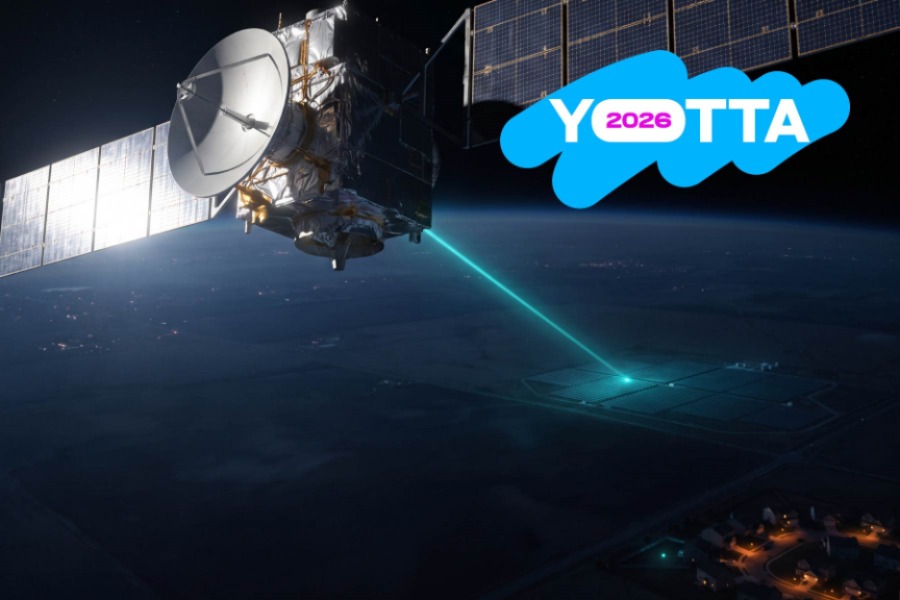
Overview Energy places satellites in geosynchronous orbit, where they receive sunlight around the clock. The satellites convert sunlight to electricity and use it to power near-infrared lasers. The lasers send an invisible beam to solar farms on the ground, so those farms produce power at night.
Al-Shakarchi said a few hundred satellites could power a single 300- to 400-megawatt training data center. The satellites can also redirect their beams. A satellite serving Las Vegas could send its energy to Morocco within minutes, he said.
“This is the world’s only movable power plant,” he added.
His company’s approach turns solar from a source that produces power 35% of the time into one that produces 70% to 90% of the time, using solar farms that already exist. Meta, one of the company’s first customers, announced a gigawatt agreement with Overview Energy in April to power its data centers from space. Al-Shakarchi said the company plans to reach orbit next year, power a U.S. utility-scale solar project in 2028 and serve its first customers in 2029.
Trevor Smith, CEO of Atomic-6, pitched a different use of orbit: data centers that operate in space. Atomic-6 builds solar arrays, radiators and debris shielding for those satellites. Smith said orbital data centers will stay small, in nodes of 100 to 200 kilowatts that connect to one another.
“You’re not going to see Costco-sized data centers flying around in space,” he said. “It just doesn’t make sense.”
Vladimir Troy, vice president of AI infrastructure at NVIDIA, said the nearest source of new power is grid capacity the country has already built. Emerald AI’s Sivaram interviewed Troy on Tuesday’s main stage. Troy said utilities build the grid to meet peak demand, and demand stays below that peak most of the time.
“Like 99% of the time, (it’s) just sitting there and being underutilized,” Troy said.
An AI factory that reduces its power draw during peak hours can use that capacity, he added. Sivaram said the U.S. grid has 100 gigawatts of available capacity today for AI factories that can operate that way. Emerald AI builds the software that lets AI factories adjust their power use. NVIDIA, Google and Emerald AI launched the AI Energy Management Alliance on Sept. 17 to advance that approach.
Sites that cannot wait for a grid connection need power generated and delivered on the campus itself. Founders and suppliers at Yotta pitched both.
Emerson Reiter, chief commercial officer and co-founder of Teragen Energy, pitched fuel cells. Teragen builds one-megawatt units that fit in a 20-foot shipping container.
“Primarily, fuel cells turn molecules to megawatts without combustion,” Reiter said.
Teragen’s cells can ramp from zero to full power in minutes rather than hours, he added. The company plans commercial deployments in 2028.
Vince Canino, president and CEO of Capstone Energy+, told TechArena that the company's gas turbines can serve a data center from groundbreaking to full operation. Each turbine has a single moving part that rides on a cushion of air, so it runs without oil, coolants or water, he said.
"Because we can move our equipment around very easily, we can start out as construction power," Canino said. "As construction is done, we can move the equipment to bridge power, and then we can put it in its final permanent position as primary power to the data center."
Constantin Eis, CEO of CMBlu Energy, pitched a water-based organic flow battery that cannot catch fire. He compared the U.S. market to Germany, his home market, which is closing power plants.
“Actually, I think the capital is there, the land is there, customers are there. The only problem which is missing is the energy,” he said.
Power generated on site still has to reach the racks. Tim Carr, senior director of business development at Veir, pitched a superconducting cable that carries the same power as a copper cable tray in a conductor one-tenth the size.
“We believe that power delivery, not just power generation, is the next necessary evolution,” he said.
Melton Chang, executive vice president of power systems at Schneider Electric, told TechArena that the company is replacing the wiring and custom hardware in medium-voltage switchgear with software. He said the change shortens time to power and moves most commissioning from the job site to the factory.
“Software-defined is not just about one product,” he said. “Software-defined is really about the system.”
Once power reaches a site, the next question is how much of it becomes tokens. Peter Panfil, vice president of power architecture and application at Vertiv, said a 100-megawatt site running at industry-norm efficiency puts about 60 megawatts to productive work at the GPU. He also cited a GPU utilization rate of about 70% that he heard three times at the conference.
“That’s a pretty damn expensive sports car to only be able to run at 70% of its capacity,” Panfil said during the Tokens Per Watt panel on Wednesday, referring to GPU capacity left unused.
Sean Corcoran, vice president of sales for PowerOne at Airsys, discussed a metric called PCE: the IT load a site provisions divided by the building load it provisions.
“It’s all about finding that waste of power and efficiently using it to compute more and more,” he said.
Power spent on cooling produces no tokens. Matthew Orcutt, vice president of strategy and systems product management at Trane Technologies, told TechArena that NVIDIA’s support for 45°C facility water lets a data center cool its GPUs with dry coolers, without chillers or compressors, for most hours of the year. LiquidStack, a Trane Technologies company, launched a coolant distribution unit at Yotta that supports that temperature. Orcutt said the amount of water a data center uses is a separate design decision.
Storage design also affects how much work each watt produces. On TechArena’s Tuesday panel, Angel Camacho, director of product marketing at Western Digital, said the industry first answered shortages by buying more storage and more power.
“Until suddenly, we hit a wall. It becomes too expensive,” he said.
Marc Austin, CEO and co-founder of Hedgehog, described a customer demonstration at Computex. One GPU ran an inference workload in 90 seconds. The same GPU, paired with a second accelerator, ran it in 30 seconds.
"Do the kind of simple math on that and it’s six times the tokens per watt, which is huge,” he said.
Betsy Chernoff, principal AI product marketing manager at WEKA, said storage has joined that calculation only recently.
“When you get over to the inference side of the house, you can have a fully utilized GPU, and still have it incredibly inefficient,” she said.
Some companies took the opposite approach and moved the compute to places where power already exists. Span, the smart electrical panel company Lander represented, places liquid-cooled inference nodes in homeowners’ side yards, next to the electrical panel. The nodes run on capacity the home does not use, and the homeowner receives subsidized energy and internet in return.
“Instead of waiting for power and traditional data center infrastructure, organizations are increasingly looking at how they can take the compute to the power,” said Angie Keeler, co-founder and CEO of Zella DC.
Submer Group launched Corenix, which builds and tests complete data center modules in a factory before shipping them to a site.
Plans to build on the ground require approval from the community around the site. Niklas Panten, co-founder and CEO of etalytics, whose software reduces the power that data center cooling plants use, said he understands the objection.
“To be honest, I don’t want (a data center) in my backyard either," he said.
Allyson Klein, founder and CEO of TechArena, moderated Wednesday’s Tokens per Watt panel and gave its final thought.
“I think that we’re going to see the focus on manageability, and how we create a control plane for operators that not just takes into account the compute infrastructure, but also storage and networking, as well as potential discussions about control of your power and cooling equipment from an integrated pane of glass,” she said. “I think that those things can provide us an ability to drive up every metric that was talked about on stage today and will bring this industry closer together. What I’m excited about is actually being here to see it all happen… This industry is incredible at innovating itself out of a problem.”
We came away from Yotta 2026 seeing the power wall as a design problem as much as a supply problem. The speakers with the most concrete answers treated power, cooling, compute, storage and networking as one system, and they measured that system by the tokens it delivers per watt. Overview Energy took the other approach: it adds new hours of output to solar farms that already exist. We expect both approaches to grow.
We see tokens per second per watt as the measure to watch. Operators who design their sites around it will add AI capacity in the next year without waiting for a place in the interconnect queue. The operators who win community approval will be the ones who can show their neighbors a stronger grid and lower rates.