
Subscribe to Our Newsletter
Read the latest in the world of AI, data center, and edge innovation.
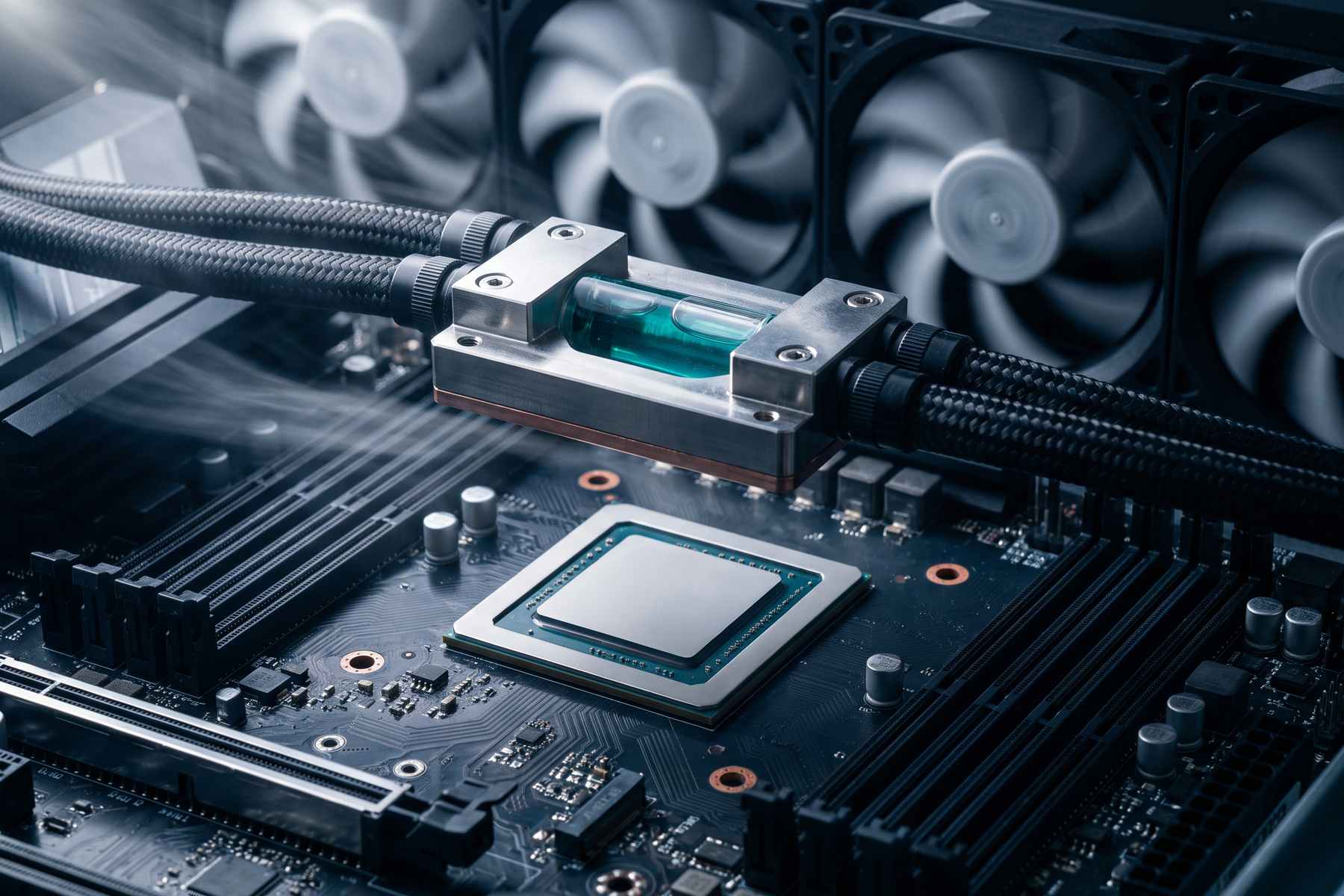

Rack densities in AI data centers are climbing faster than anyone predicted. NVIDIA’s NVL72 racks already draw well over 100 kilowatts, and the upcoming NVL576 is expected to push past 600 kilowatts. Cooling is no longer an afterthought, but one of the defining constraints on AI infrastructure deployment, performance, and economics.
At AI Infra Summit, TechArena’s Allyson Klein sat down with Jeff Moore, VP of Strategic Partnerships at Airsys, to discuss these challenges. Airsys has 30 years’ experience, having started in comfort cooling before expanding into mission-critical applications. Its technology has since earned a TechArena award for innovation in AI infrastructure.
Moore’s central message: most of the industry isn’t moving to liquid cooling overnight, and solutions must accommodate existing infrastructure while preparing for higher-density compute.
Hyperscalers and large-scale AI factories face the most extreme cooling requirements, but many facilities are transitioning more gradually, with GPU platforms that can still be supported by air cooling. Operators want to maximize existing space and power capacity while introducing liquid cooling without extensive capital investment or facility redesign. Supporting that phased transition, rather than forcing a complete overhaul, is where Moore sees the strongest fit for the Airsys portfolio.
As densities rise, operators want to direct as much of their available power as possible toward compute. “Every watt that goes to the GPU has a thermal obligation with it,” Jeff explained. Cooling infrastructure must therefore accommodate both current thermal loads and the requirements of future silicon generations.
Compressed timelines add further pressure. Every delay between hardware installation and operational readiness represents lost revenue potential, so cooling has to be delivered and installed on schedule. Airsys supports production from its new half-million-square-foot global headquarters campus in Woodruff, South Carolina, as well as manufacturing facilities in Hungary and China.
Jeff also pointed to growing silicon diversity as inference spreads beyond a single vendor. GPU power requirements are increasing, while emerging 800-volt DC architectures are changing how power is distributed within AI infrastructure. Airsys emphasizes design flexibility and rapid prototyping to accommodate evolving customer specifications, component configurations, and thermal requirements.
One of Airsys’s key technical differentiators is additive manufacturing. Jeff recalled standing in a booth at OCP two years ago with Airsys founder Yunshui Chen, discussing 3D-printed cold plates when industry adoption was still limited. Today, multiple companies have introduced alternative manufacturing techniques, from ECAM to stack forging.
Airsys uses laser powder bed fusion, an additive manufacturing process established in aerospace that builds metal components layer by layer from digital designs. The company works primarily with aluminum and copper but can incorporate other materials to meet specific performance requirements. Printing enables more complex internal structures, increasing the surface area available for heat transfer and improving thermal performance.
The approach also shortens design and prototyping cycles. As NVIDIA accelerates its GPU development roadmap, cooling suppliers must adapt to new thermal and mechanical requirements on increasingly compressed timelines. Where conventional cold plate manufacturing may require new tooling, additive manufacturing enables Airsys to iterate designs without the same production constraints.
Power usage effectiveness (PUE) has long been the industry’s standard metric for data center energy efficiency. But PUE measures total facility energy consumption relative to IT equipment energy use, rather than how productively that energy is converted into compute. Allyson, who worked on PUE during her time at Intel, observed that the industry may have placed too much emphasis on infrastructure efficiency without adequately accounting for computational output.
Airsys has introduced a complementary metric: power compute effectiveness (PCE). Where PUE measures operating energy efficiency, PCE measures allocation or the share of a facility's provisioned power that's available for compute. The more power that can go to compute, the more AI capacity a site can support within the same grid connection.
AI infrastructure conversations often focus on greenfield builds, but many operators must accommodate higher-density workloads within existing data centers equipped with legacy systems like computer room air conditioning (CRAC) units. Jeff, who recently joined a panel with Equinix and colocation providers, emphasized that these purpose-built facilities need a practical upgrade path as customer requirements evolve.
The answer from Airsys is LiquidPack, a single-phase solution designed to fit within a standard rack footprint. It uses contained impingement spray cooling, with servers installed in cassettes and substantially less fluid than conventional immersion cooling. Because it connects to existing facility water infrastructure, operators can introduce liquid cooling without a facility overhaul.
Jeff said operator response has been very positive. Applications extend to the edge, where Airsys already cools converted cell sites and telecom properties, as well as modular data center deployments.
When Airsys first began developing 3D-printed cold plates, the goal was removing two kilowatts of heat. Today, servers integrate multiple GPUs and CPUs within increasingly dense rack-scale architectures, and focusing on the cold plate alone won't cut it.
Jeff argued for evaluating the complete thermal management system, including piping, coolant properties, phase-change behavior in two-phase architectures, manifolds, and the coolant distribution unit (CDU). System-level instrumentation provides the visibility needed to monitor fluid behavior, manage operating conditions, and optimize heat removal across the entire cooling loop.
Two-phase cooling offers the potential for greater heat transfer efficiency, but refrigerant selection introduces environmental, safety, and operational considerations. Jeff sees progress in the development of PFAS-free alternatives. “I think we’re going to innovate our way forward,” he said, pointing to new refrigerants that have emerged over the past six to 12 months.
Single-phase cooling remains well established, with additive manufacturing extending its capabilities through more effective cold plate designs. However, increasing thermal loads will eventually push the practical limits of coolant flow rates, operating temperatures, and heat removal capacity. Two-phase systems offer another path forward, provided the industry can establish reliable, safe, and scalable approaches to deployment.
AI infrastructure is advancing faster than traditional cooling architectures can comfortably accommodate. Yet the transition to liquid cooling won't happen overnight, and operators need solutions that address immediate thermal demands while leaving room for future generations of compute.
Airsys is approaching that challenge from multiple directions, combining additive manufacturing, system-level thermal management, and a portfolio spanning air, single-phase liquid, and emerging two-phase technologies. Its emphasis on power compute effectiveness also reflects a broader shift in how the industry evaluates infrastructure: by how much provisioned power a facility makes available for compute.
Ultimately, the next generation of AI cooling will require greater flexibility across technologies, facility types, and deployment models. Every additional watt directed toward compute creates a corresponding thermal obligation and meeting that demand will be essential to scaling AI infrastructure efficiently.
To hear more about Airsys and their innovative approach to AI cooling, listen to the full episode.